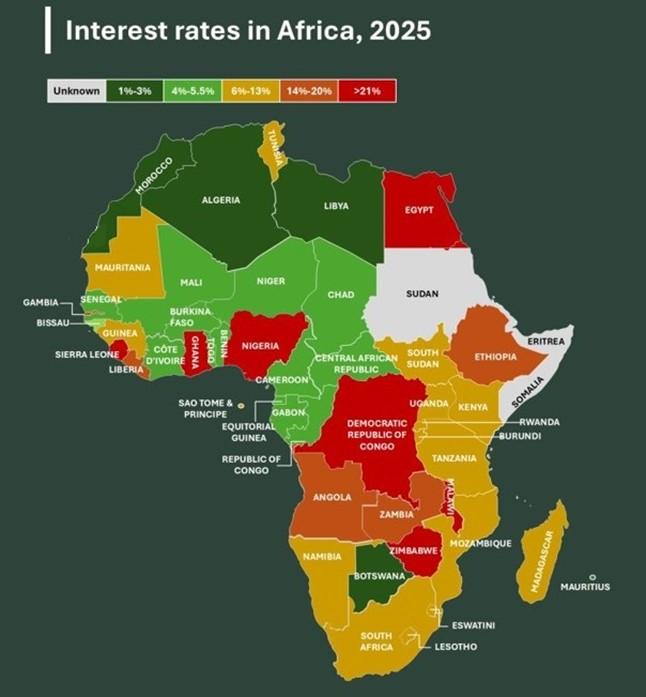
When discussing interest rates in Africa, attention often focuses on extreme cases. Countries like Zimbabwe, with a policy rate nearing 35%, or Ghana, around 28%, illustrate the difficulties faced by some economies grappling with high inflation and monetary instability. However, these dramatic situations do not reflect the full diversity of the African financial landscape.
In several countries across the continent, policy rates remain relatively low, reflecting stronger macroeconomic stability. In Botswana, for example, the interest rate is around 1.9%. This relatively low level is part of a financial environment characterized by high levels of financial inclusion, with nearly 69% of the population having access to banking services. Similarly, Morocco has a policy rate of approximately 2.25%, supported by a relatively stable and growing economy.
Conversely, economies like Nigeria and Zimbabwe are forced to maintain high interest rates to contain inflationary pressures and stabilize their currencies. In Nigeria, for example, the policy rate is around 27.5% in a context of inflation close to 28%.
These discrepancies illustrate a veritable “lottery” of interest rates across the continent, reflecting differences in economic structures, monetary policies, and levels of financial development. It is important to remember, however, that these figures correspond to central bank policy rates. In practice, the rates applied by commercial banks are generally two to five percentage points higher, which directly impacts the real cost of credit for businesses and households.