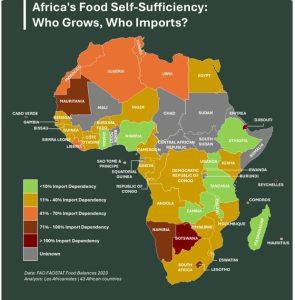
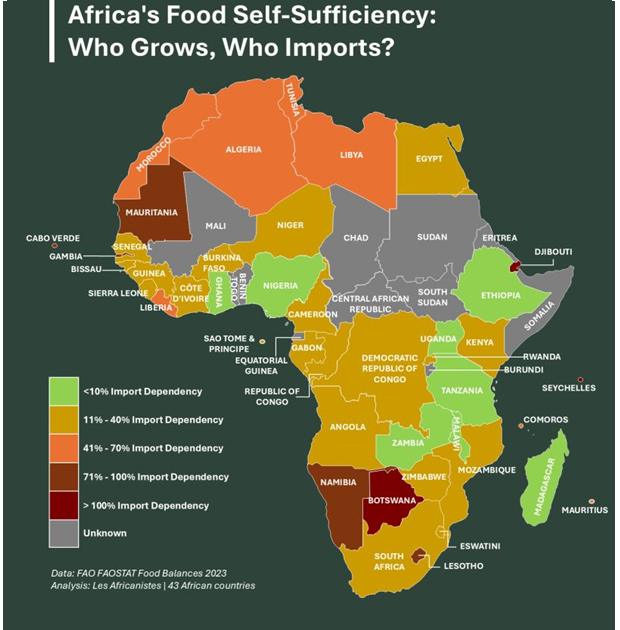
Across the continent, Africa’s food dependency is estimated at around 19%. However, this overall figure masks significant disparities between countries and between different categories of food products.
Some regions are particularly dependent on imports. This is notably the case for several small island states or countries with severe climatic constraints. Djibouti, for example, has a dependency rate exceeding 150%, while the Seychelles, Mauritius, and Botswana also surpass 100%. In these economies, geographical or environmental conditions severely limit local agricultural production.
In other regions, particularly in North Africa, food dependency is at intermediate levels. Morocco, for example, has a rate of around 48%, while Algeria and Tunisia are around 38% and 37% respectively.
Conversely, some of the continent’s major agricultural producers appear largely self-sufficient. Malawi, Nigeria, and Ethiopia, for example, have dependency rates of less than 10%, thanks to significant local agricultural production.
However, this apparent self-sufficiency can be misleading. Even relatively self-reliant countries, such as Uganda, remain heavily dependent on imports for certain key products, including wheat, vegetable oils, and sugar. This situation creates a paradox: locally produced food can remain affordable, while a more diversified diet becomes expensive due to dependence on international markets.
Thus, the real issue of food security in Africa is not limited to the overall volume of production, but also concerns the structure of imports and the diversification of agricultural systems.