In 2026, Africa will reach a major symbolic milestone: its economy will reach $3.32 trillion, according to estimates from the International Monetary Fund. This figure confirms a gradual but profound transformation of the continent, which can no longer be considered solely as an emerging economy, but as a truly consolidating economic bloc.
This rise to power is largely based on the emergence of strong regional leaders. South Africa tops the ranking with a gross domestic product (GDP) of $444 billion, closely followed by Egypt ($400 billion) and Nigeria ($334 billion). Algeria ($285 billion) and Morocco ($196 billion) complete the top five, illustrating the diversity of economic models on the continent, encompassing natural resources, industrialization, and services.
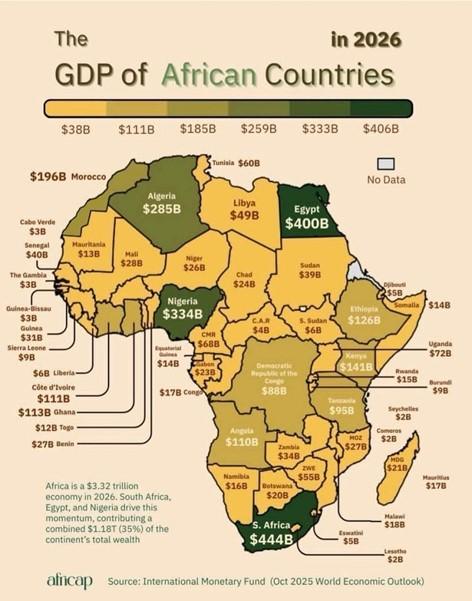
Beyond these major economies, a new dynamic is at work: several countries have now crossed the $100 billion GDP threshold. Kenya ($141 billion), Ethiopia ($126 billion), Ivory Coast ($111 billion), Ghana ($113 billion), and Angola ($110 billion) embody this new generation of high-growth economies. Their progress reflects a gradual diversification of economic drivers, notably through urbanization, investment, and infrastructure development.
These developments show that Africa is no longer simply a “growth story,” but a structured economic space composed of several centers of power. The continent is gaining in weight, complexity, and influence, both regionally and internationally.
Long-term prospects reinforce this trend. By 2050, Africa’s population could reach 2.5 billion, driven by rapid urbanization and an expanding middle class. Simultaneously, the burgeoning entrepreneurial ecosystem—particularly in startups and technology hubs—is attracting increasing amounts of capital, fostering innovation and economic transformation.
Another key lever lies in the development of intra-African trade. With the gradual implementation of the African Continental Free Trade Area (AfCFTA), trade between African countries should become more fluid, competitive, and integrated. This dynamic could reshape the continent’s economic landscape by strengthening regional complementarities.
Thus, Africa in 2026 is no longer defined solely by its challenges. It is emerging as a dynamic economic entity capable of generating wealth on a massive scale. The challenge for the coming decades will be to consolidate this growth, make it more inclusive, and transform this potential into sustainable power.
The continent’s economic history is only just beginning — and it is now being written on a trillion-dollar scale.
