In 2025, Africa’s total exports reached approximately $615 billion, confirming a significant increase compared to previous years. This growth reflects the continent’s economic potential, but it also highlights a persistent characteristic: its heavy dependence on natural resources.
Three main categories dominate African exports. Energy products, particularly oil and gas, alone account for approximately $280 billion. Next come minerals and precious metals, at nearly $145 billion, followed by agricultural products, estimated at $85 billion. This structure reflects an economy still largely focused on the extraction and export of raw materials.
Certain countries stand out due to their significant share of the continent’s trade. South Africa leads the way with approximately $145 billion in exports, driven by a relatively diversified economy, though still heavily reliant on mineral resources. Nigeria follows with $133 billion, primarily thanks to its oil exports. Algeria ($105 billion), Morocco ($93 billion), and Egypt ($77 billion) complete this group of leaders, each with slightly different profiles but all characterized by a strong presence in traditional sectors.
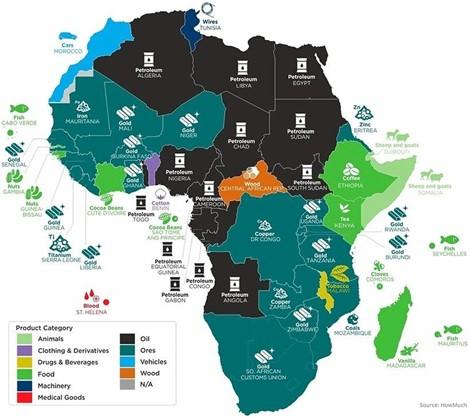
Data from sources such as the Observatory of Economic Complexity (OEC), the UN Comtrade database, and various trade reports confirm this structural trend. Although some developments are emerging—such as the rise of refined petroleum products in certain countries—they remain marginal compared to the dominance of raw materials.
This specialization offers short-term advantages, particularly in terms of export revenue. However, it also exposes African economies to high volatility in international prices and limits the creation of local added value. Exporting crude oil or unprocessed minerals often means foregoing industrial opportunities, skilled jobs, and economic upgrading.
The challenge for Africa is therefore not just to increase its exports, but to transform them. This involves developing local value chains, industrially processing resources, and diversifying towards higher value-added sectors, such as manufacturing, services, or technology.
Thus, while the continent possesses undeniable natural wealth, its true potential lies in its ability to move beyond the extractive model. The future of African exports will depend less on what it sells than on how it processes it.
