
The landscape of major African companies reveals both the continent’s potential and the persistent imbalances in its economic structure. Today, Africa has approximately 345 companies generating over one billion dollars in annual revenue, nearly 230 of which are based on the continent. This figure, while significant, highlights a contrasting reality: African economic power exists, but it remains highly concentrated geographically and sectorally.
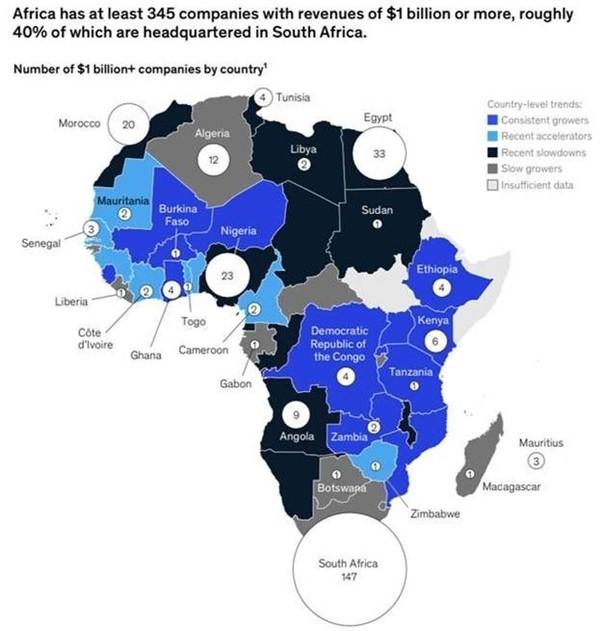
South Africa dominates this ranking with approximately 147 companies, representing nearly 40% of the total. This position is explained by its historically industrialized economy, developed financial markets, and a favorable environment for large companies. Egypt follows with 33 companies, benefiting from the size of its domestic market and sustained investment in infrastructure. Nigeria (23 companies), the continent’s most populous nation, and Morocco (20 companies), driven by a strategy of economic diversification, complete the top group.
Behind these leaders, other countries have a more modest but significant presence. Algeria has 12 companies of this size, followed by Angola (9), Kenya (6), and then several countries such as Ethiopia, Ghana, the Democratic Republic of Congo, and Tunisia, with four companies each. Further down the ranking, economies like Senegal and Mauritius have three, while several other countries have only one or two.
This uneven distribution highlights a high concentration of large companies in a few economic hubs across the continent. It also reflects disparities in industrialization, access to finance, market size, and economic stability.
Furthermore, these companies operate primarily in traditional sectors such as energy, mining, and telecommunications. While these areas are essential pillars of the African economy, they also reflect a persistent dependence on natural resources and basic infrastructure, to the detriment of higher value-added sectors such as advanced manufacturing or technology.
Furthermore, these companies operate primarily in traditional sectors such as energy, mining, and telecommunications. While these areas are essential pillars of the African economy, they also reflect a persistent dependence on natural resources and basic infrastructure, to the detriment of higher value-added sectors such as advanced manufacturing or technology.
This situation raises a strategic question for the future of the continent: how to broaden this base of billion-dollar companies and make it more diverse? The development of a denser entrepreneurial fabric, industrialization, regional integration, and an improved business environment will be crucial to the emergence of new economic champions.
Thus, while Africa already possesses a solid core of large companies, its real challenge lies in expanding and transforming this economic elite. For beyond sheer numbers, it is the capacity to create value, innovate, and diversify that will determine the continent’s place in tomorrow’s global economy.
