
The ranking of African ports for the period 2025/2026 highlights a profound transformation of the continent’s maritime landscape. More than ever, port competitiveness no longer relies solely on the volumes handled, but on a combination of key factors: logistical efficiency, infrastructure modernization, quality of governance, and the ability to adapt to the demands of international trade.
The ports that dominate this ranking—Tangier Med, Port Said, Durban, Alexandria, Lomé, Mombasa, Lagos, Abidjan, Djibouti, and Tema—illustrate this trend. Their performance is explained by massive investments in infrastructure, optimized flow management, and the increasing integration of digital technologies. These hubs have now established themselves as key points in African trade, capable of meeting increasingly demanding international standards.
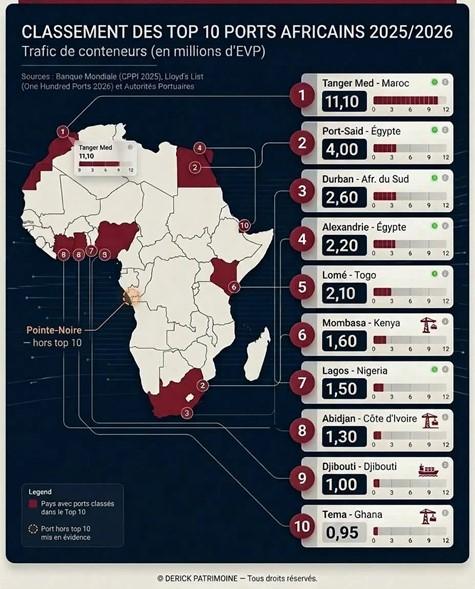
In this context, the absence of the autonomous port of Pointe-Noire from the top 10 should not be interpreted as an irreversible delay, but rather as a strategic signal. The port’s potential remains significant, particularly due to its geographic location and regional role. However, to compete with the continent’s leaders, substantial efforts are needed.
Several areas for improvement are essential. Modernizing the docks and equipment is a priority for increasing capacity and operational performance. At the same time, simplifying procedures and digitizing port services would reduce delays and improve operational efficiency. Better organization of logistics flows is also crucial to limit congestion and optimize the movement of goods.
Beyond technical aspects, the integration of corporate social and environmental responsibility (CSR) criteria, as well as the use of sustainable financing, are becoming key factors in the attractiveness of ports. In a global context marked by increased sustainability requirements, these dimensions are no longer optional, but strategic.
Finally, strengthening partnerships with international players — investors, logistics operators and financial institutions — is a key lever to accelerate the transformation of the port and strengthen its positioning.
Thus, port competitiveness in Africa is entering a new era. It is no longer measured solely by the size of infrastructure, but also by the quality of services, the resilience of systems, and the capacity for innovation. For ports like Pointe-Noire, the challenge is clear: to transform their potential into sustainable performance in order to fully participate in the dynamics of global trade.
