Artificial intelligence is now emerging as a major driver of global economic power. In this context, Africa is gradually entering the competition, with progress that is still uneven but accelerating rapidly. The question is no longer whether the continent will participate in this revolution, but what role it will play.
To date, only 16 African countries have officially launched a national artificial intelligence strategy, while 34 others are in the process of developing policies and a few have not yet begun this process. Among the most advanced countries are Egypt, Algeria, Kenya, Rwanda, Ghana, Senegal, Morocco, Tunisia, South Africa, and Nigeria. These states are laying the groundwork for AI governance and seeking to structure their digital ecosystems.
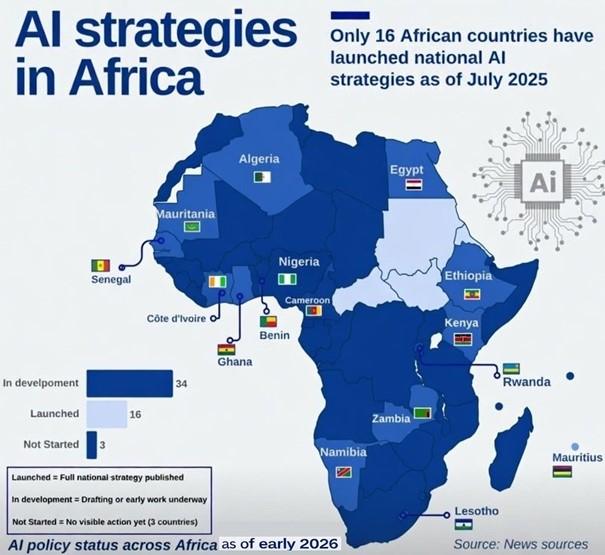
Beyond formal strategies, a deeper dynamic is emerging. Several major initiatives arose between 2025 and early 2026. Kenya, for example, aims to become a regional AI research hub through its 2025-2030 national strategy. Ethiopia is integrating artificial intelligence into the heart of its “Digital Ethiopia 2030” program, combining cybersecurity, digital infrastructure, and innovation. Morocco, for its part, aims for a $10 billion contribution from AI to its GDP by 2030, by investing heavily in training, infrastructure, and data centers.
At the same time, international partnerships are multiplying to support the development of so-called “sovereign” artificial intelligence in Africa. Foreign investment is also increasing, with major initiatives aimed at strengthening AI-related infrastructure and services on the continent.
However, this progress is accompanied by significant structural challenges. Insufficient computing power, a lack of specialized talent, shortcomings in data governance, and dependence on foreign cloud infrastructure are hindering the development of a self-sustaining ecosystem. Added to this are risks associated with the use of AI, particularly regarding oversight and inadequate regulation in certain contexts.
These constraints contribute to widening the gap between the most advanced countries and those struggling to keep pace. An internal technological divide could thus worsen if inclusive and coordinated policies are not implemented.
However, the stakes extend beyond the continent. With a population of 1.4 billion, a rapidly growing digital market, and the youngest population in the world, Africa represents a strategic battleground for the future of artificial intelligence. The choices made today regarding infrastructure, training, and regulation will have a decisive impact over the next 20 to 30 years.
Africa is thus at a crucial turning point. It can become a creative force, capable of developing its own solutions and models, or remain a mere user of technologies designed elsewhere. The race is on, and the coming decade will be decisive in defining the continent’s place in the global digital economy.
