
East Africa is often perceived as a collection of countries with distinct trajectories. Yet, this fragmented view masks a deeper reality: the region possesses all the necessary elements to become a powerful, globally competitive, and integrated economic system. The real challenge is not a lack of resources, talent, or opportunities, but rather the absence of strategic coordination among its states.
Each country in the region possesses its own specific strengths. Tanzania has established itself as a key player in port infrastructure, natural resources, and energy. Kenya, for its part, stands out for its leadership in technology, finance, and regional connectivity. Uganda benefits from a robust agricultural sector and growing oil potential. Rwanda is emerging as a services and logistics hub, focusing on efficiency and good governance. Finally, Burundi has largely untapped agricultural potential.
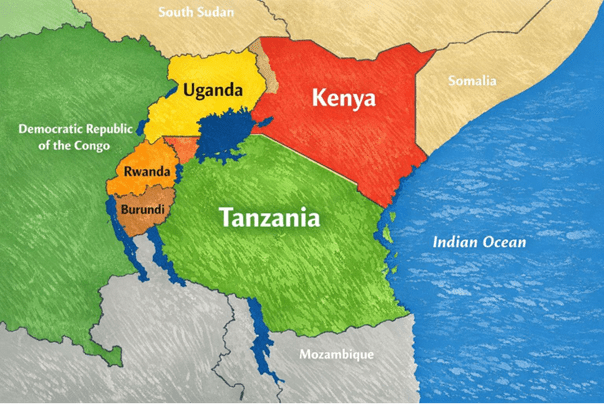
Taken individually, these strengths may seem limited. But together, they form the pieces of a coherent and complementary economic puzzle. The problem lies in the fact that these countries continue to operate as independent entities, often competing rather than collaborating. They vie for the same investors, develop similar industries, and build parallel systems, instead of integrating them.
Meanwhile, other regions of the world are progressing more rapidly thanks to better organization and a collective vision. The European Union and ASEAN, for example, have demonstrated that regional integration increases competitiveness, optimizes resources, and strengthens economic resilience.
Envisioning East Africa functioning as an integrated system is not utopian, but a realistic strategy. In this model, Tanzania could serve as the logistical and energy backbone, Kenya as the financial and technological engine, Uganda as the agricultural powerhouse, Rwanda as the service and efficiency hub, and Burundi as the emerging production base. Such an organization would maximize each country’s comparative advantages while reducing redundancies.
The future of East Africa will therefore depend not only on the individual performance of its states, but also on their ability to cooperate, harmonize their policies, and build regional value chains. The question is no longer whether the resources exist—they are already there—but whether the political will and a shared vision will follow.
Thus, East Africa is not simply a geographical region. It is an economic system awaiting organization. And its future success will depend on a key decision: to continue moving forward separately, or to choose to evolve together.
