Africa’s rapid urbanization is often presented as one of the drivers of the continent’s economic transformation. Yet, behind the narrative of a “growing Africa,” a more nuanced reality emerges: in many cities, urban expansion is accompanied by a sharp increase in informal settlements.
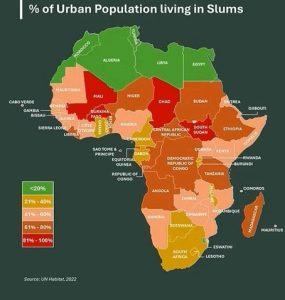
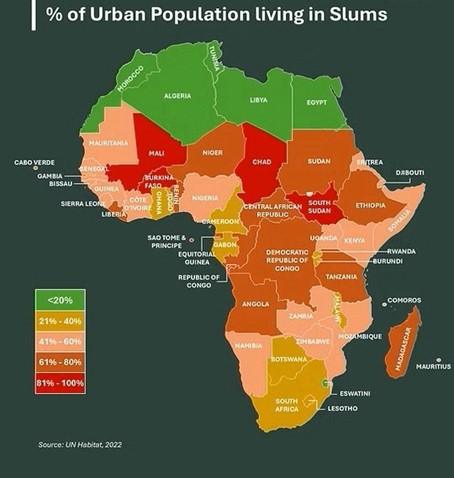
A clear geographical divide exists between North Africa and sub-Saharan Africa. In several North African countries, the proportion of the urban population living in slums remains relatively low, generally less than 20%. Egypt, for example, has a rate of around 3.8%, the result of significant investments in urban planning, infrastructure, and housing policies.
Conversely, in much of sub-Saharan Africa, more than half of the urban population lives in informal settlements. The most extreme situations are found in South Sudan, where approximately 94% of urban dwellers live in slums, but also in Mali (92%), Burkina Faso (87%), and Chad (82%).
However, some countries offer more encouraging examples. Eswatini has one of the lowest rates in sub-Saharan Africa at around 17%, while South Africa, with 24.2%, stands out among the region’s major economies.
These differences highlight a key factor: the quality of urban planning. Countries that have invested in infrastructure, land-use planning, and land tenure security have lower rates of informal settlements.
If current trends continue, sub-Saharan Africa could have approximately 360 million more inhabitants living in slums by 2030. The real challenge, therefore, is not urbanization itself, but the capacity to organize and sustainably manage it.