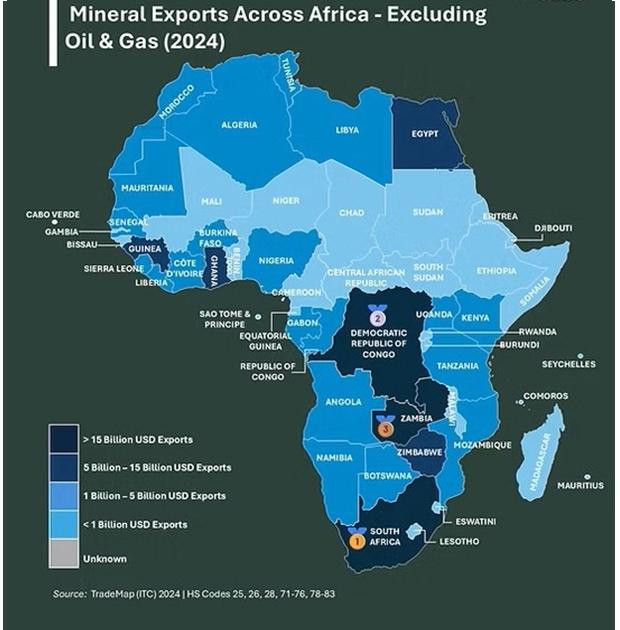
When examining natural resource exports in Africa, oil and gas often dominate the analysis. However, removing hydrocarbons from the equation profoundly transforms the continent’s economic landscape, revealing the true power of solid mining.
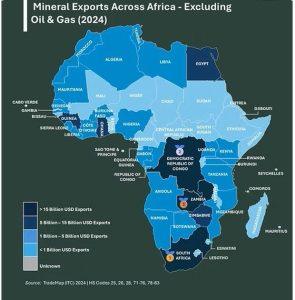
In this ranking of non-oil and gas mining exports, South Africa is far ahead with approximately $52.2 billion. The country boasts a diversified mining sector based on platinum, gold, diamonds, as well as iron, copper, nickel, and certain rare earth elements. The Democratic Republic of Congo holds second place with nearly $48.7 billion in exports, dominated by copper and cobalt. The latter represents about 60% of global supply, giving the country strategic importance in the energy transition.
Zambia ranks third with approximately $16.7 billion in exports, primarily related to copper from its renowned Copperbelt. Egypt occupies fourth place with $11.4 billion, thanks in particular to copper, iron, and certain rare earth elements. Finally, Guinea completes the ranking with approximately $8.9 billion, driven by its vast bauxite reserves, among the largest in the world.
These five countries alone account for nearly 67% of African non-hydrocarbon mineral exports. Conversely, countries heavily dependent on oil, such as Nigeria, Algeria, and Angola, have fallen sharply in the rankings. This shift reveals the growing strategic importance of minerals in the global economy and underscores the need for Africa to strengthen the local processing of its mineral resources.