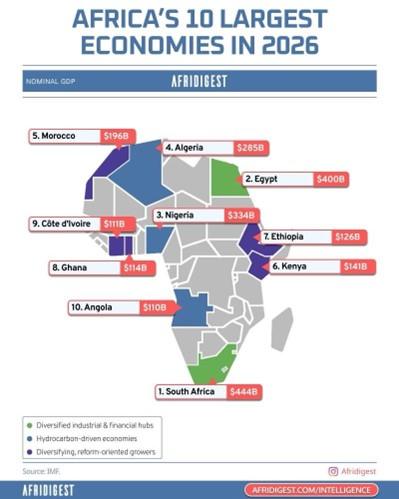
In 2026, the ranking of the largest African economies highlights three undisputed leaders: South Africa ($444 billion), Egypt ($400 billion), and Nigeria ($334 billion). These countries concentrate a significant share of the continent’s wealth, but their economic dynamics reveal contrasting realities and distinct structural challenges.
South Africa remains the most developed economy on the continent, thanks to a diversified industrial base, deep financial markets, and advanced infrastructure. However, this position is weakened by persistent constraints, including energy problems, high unemployment, and moderate economic growth.
Egypt, for its part, benefits from a large, young, and dynamic domestic market, as well as a strategic geographic location linking Africa to the Middle East. Massive infrastructure investments support its growth, even though the country remains committed to IMF-backed economic reforms, particularly to stabilize its currency and macroeconomic balances.
Nigeria, the continent’s most populous nation, illustrates a major paradox: despite its large population, its economy remains below its potential. Currency depreciation and macroeconomic instability have reduced the nominal value of its GDP, creating a significant gap between its demographic size and its real economic power.
Beyond this top three, an analysis of the ten leading African economies reveals three main groups with distinct drivers and trajectories. The first comprises diversified and structured economies, such as South Africa and Egypt, where industry and financial services play a central role. The second includes economies heavily dependent on hydrocarbons, such as Nigeria, Algeria, and Angola, whose performance remains closely tied to fluctuations in energy prices. Finally, a third group emerges, made up of countries undergoing diversification and reform—such as Morocco, Kenya, Ethiopia, Côte d’Ivoire, and Ghana—which are focusing on industrialization, services, and proactive economic policies to accelerate their growth.
This analysis highlights a crucial reality: current economic size reflects past value accumulation, but it does not necessarily predict future trajectories. Some countries that are currently dominant could see their position shift, while others, undergoing significant transformation, could gain importance in the years to come.
Thus, the African economy cannot be reduced to a static ranking. It is in motion, driven by multiple and sometimes divergent dynamics. Understanding these trajectories is essential to anticipating future opportunities and transformations on the continent.
