Since the mid-20th century, Africa has experienced remarkable population growth, which is gradually redefining its role on the world stage. Between 1950 and 2018, all major regions of the continent saw their populations increase significantly, illustrating an unprecedented demographic dynamic.
West and East Africa stand out in particular for their rapid growth. This development is largely explained by high birth rates and accelerated urbanization in key countries such as Nigeria, Ethiopia, and Tanzania. These regions now concentrate a significant portion of the African population, with rapidly expanding cities and a growing youth population.
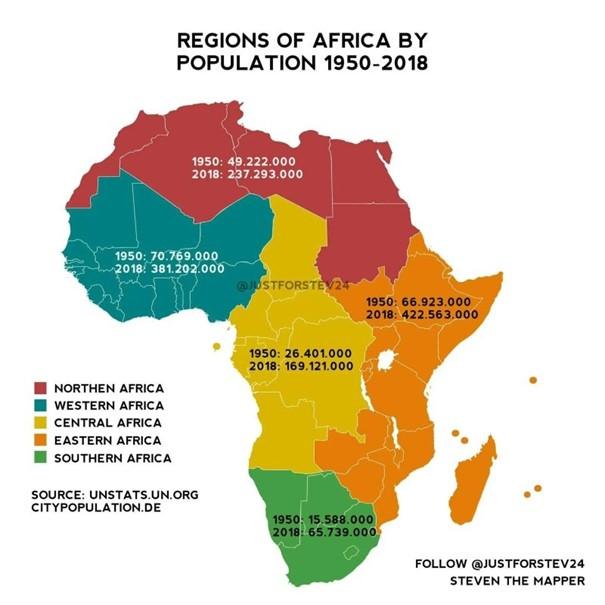
Other regions, such as North and Central Africa, have also experienced substantial population growth, although at a more moderate rate. Southern Africa, on the other hand, has seen slower growth, characterized by different demographic dynamics, notably linked to more advanced demographic transitions and specific socio-economic contexts.
This rapid expansion of the African population is not merely a statistical phenomenon. It constitutes a structuring factor for the continent’s future. A young and growing population represents both an opportunity and a challenge: an opportunity in terms of labor, innovation, and consumption, but a challenge in terms of employment, education, infrastructure, and governance.
Globally, this demographic dynamic gives Africa increasing importance. The continent is destined to play a central role in the economic, social, and political balances of the coming decades. Its rapidly growing population will influence markets, migration flows, production models, and public policies far beyond its borders.
Thus, African population growth appears as one of the major determinants of its future. If managed well, it can become a powerful driver of development and transformation. If poorly anticipated, it risks exacerbating existing imbalances. More than ever, the challenge is to transform this dynamic into a sustainable strategic advantage.
