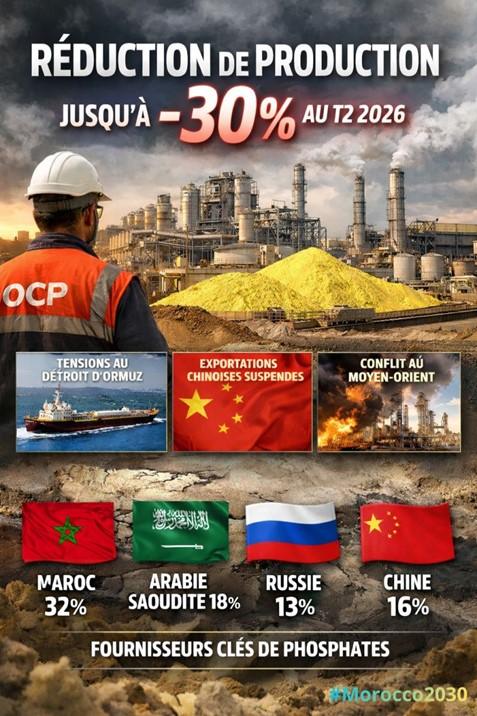
In an international context marked by significant uncertainty, the OCP Group, a world leader in phosphates, is adjusting its strategy to strengthen its industrial resilience and maintain its position in global markets. The announcement of the early implementation of its maintenance program, which could lead to a reduction of up to 30% in its production capacity in the second quarter of 2026, reflects this proactive approach in the face of current challenges.
This decision comes in a particularly complex environment, dominated by growing geopolitical uncertainties and disruptions to supply chains. One of the key elements concerns the supply of sulfur, a raw material essential for the production of phosphate fertilizers. Tensions around the Strait of Hormuz, a strategic point in global trade, exacerbate the risks related to the availability and cost of this resource.
Far from being a mere constraint, this proactive approach reflects a strategic strategy. The OCP Group seeks to optimize its industrial assets, enhance the flexibility of its operations, and ensure the long-term reliability of its facilities. By adjusting its maintenance schedule, the company aims to better manage production cycles in a volatile environment, while preserving its future capacity.
The situation is all the more critical given that the global fertilizer market is already experiencing significant disruptions. The temporary suspension of Chinese exports of products such as DAP, MAP, and NP is reducing the international supply. At the same time, tensions in the Middle East are disrupting the flow of raw materials, while rising energy and logistics costs are increasing production costs for all players in the sector.
In this context, importers are becoming increasingly dependent on a limited number of strategic suppliers. Morocco, through OCP, accounts for approximately 32% of global supply, followed by Saudi Arabia (18%), China (16%), and Russia (13%). This concentration reinforces the central role of these countries in maintaining market equilibrium.
Any further reduction in production, even temporary, could exacerbate supply tensions and put upward pressure on fertilizer prices. This would have direct repercussions on agricultural costs worldwide, in a context where food security remains a major concern for many countries.
Beyond its immediate implications, this situation illustrates a broader evolution in commodity markets. The ability to anticipate shocks, secure supplies, and adapt industrial strategies is becoming a determining factor in competitiveness.
Therefore, the OCP Group’s decision is part of a strategic risk management approach. It reflects the need for major industrial players to navigate an increasingly uncertain global environment. In this new balance, control of supply chains and operational flexibility appear as essential levers for maintaining a leading position in international markets.