Africa is often described as a resource-rich continent. But this view, while accurate, remains incomplete. In reality, the continent is a strategic pillar of global supply chains. From energy and minerals to agriculture, its exports fuel key industries worldwide.
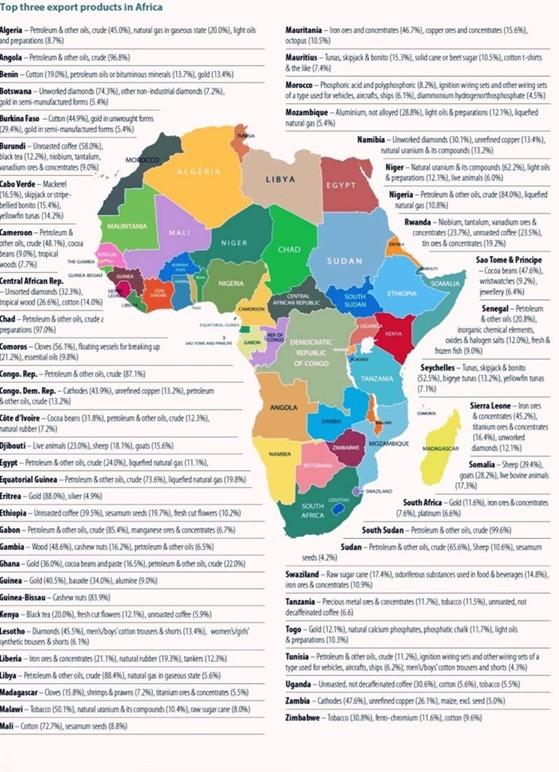
The primary driver of this dynamic remains the energy sector. In several countries, hydrocarbons overwhelmingly dominate exports. Nigeria derives approximately 84% of its export revenue from crude oil, while Angola is nearly 97% dependent on it. Algeria, for its part, is among the leading suppliers of oil and gas. On a continental scale, petroleum products have historically accounted for nearly half of African exports. This dependence underscores a crucial fact: Africa plays a vital role in global energy security, particularly in an uncertain geopolitical context.
The continent is also a leading mining power. Southern and Central Africa hold significant strategic resources: South Africa for gold and platinum, Botswana for diamonds, and the Democratic Republic of Congo for copper. These raw materials fuel global industries, from electronics to construction. However, a large portion of these resources is exported in their raw state, which limits value creation locally.
Meanwhile, agriculture is another pillar of African exports. West and East Africa are distinguished by their production of cocoa, coffee, cotton, and tea. Côte d’Ivoire, the world’s leading cocoa exporter, exemplifies this strategic position. Kenya is a major player in tea and flowers, while countries like Mali and Burkina Faso play a key role in cotton production. These products supply global industries ranging from food processing to textiles.
Despite this diversity, one constant remains: over 60% of African exports are based on raw materials. This structure exposes the continent to the volatility of international prices and to a dependence on external demand. In other words, Africa contributes significantly to the global economy, but still captures a limited share of the value generated.
However, a transformation is underway. More and more countries are engaging in the local processing of resources, whether in mineral processing (lithium, copper, gold) or in agribusiness (cocoa, cashew nuts, coffee). Gradual industrialization and the development of intra-African trade, particularly through the African Continental Free Trade Area (AfCFTA), are opening up new opportunities.
The strategic challenge is therefore no longer simply to export, but to integrate into value chains. Africa is thus beginning a transition: moving from the status of raw material supplier to that of strategic industrial partner.
For investors, this evolution is crucial. Opportunities now lie in infrastructure, transformation capabilities, trade finance, and logistics integration. Those who can anticipate this shift will be best positioned to capture the continent’s next phase of growth.
Thus, Africa is not only at the origin of global trade flows: it is redefining its place within these value chains.
