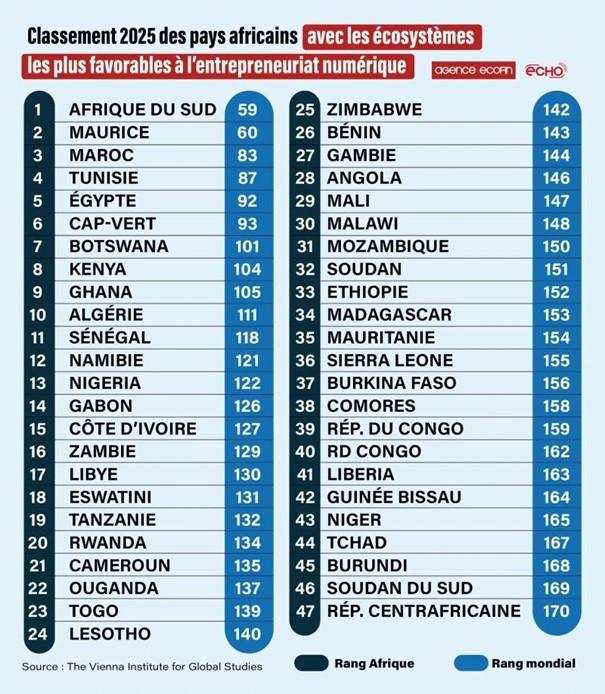
By 2025, the ranking of African countries with the best-performing digital entrepreneurship ecosystems will highlight a quiet but decisive transformation: the emergence of a continent driven by innovation, startups, and technology. At the heart of this dynamic, one key factor stands out as the true engine of growth: human capital.
The most successful ecosystems aren’t just those that attract the most funding or have the largest number of startups. They are distinguished above all by their ability to train, retain, and develop talent. Developers, engineers, data scientists, entrepreneurs: these profiles represent the most valuable strategic resource in today’s digital economy.
Some African countries stand out in particular by structuring environments conducive to innovation. They combine several essential elements: appropriate public policies, developing digital infrastructure, access to financing, and, above all, training and support programs for entrepreneurs. This combination makes it possible to create dynamic ecosystems capable of competing internationally.
However, this performance remains unevenly distributed across the continent. While some technology hubs—particularly in East, West, and North Africa—are experiencing strong growth, other regions are still struggling to structure their ecosystems. Disparities in access to education, connectivity, and funding are hindering the emergence of new players.
In this context, investing in talent emerges as a strategic priority. It’s not just about developing technical skills, but also about cultivating an entrepreneurial spirit, a capacity for innovation, and an understanding of global issues. Initiatives aimed at supporting young entrepreneurs, encouraging research, and facilitating access to resources play a crucial role.
Furthermore, the commitment to African entrepreneurs in new technologies now extends beyond the local level. International investors, incubators, and large corporations are increasingly interested in the opportunities offered by the continent. This openness creates new perspectives, but it also reinforces the need to build strong and self-sustaining ecosystems.
Africa’s digital future will therefore depend on its ability to transform its human potential into a sustainable competitive advantage. The countries that succeed will be those that place education, innovation, and entrepreneurship at the heart of their development strategy.
Thus, more than just a ranking, the performance of African digital ecosystems reveals a fundamental trend: the shift from a resource-based economy to a talent-based economy. And in this transition, investing in today’s skills means building tomorrow’s technology leaders.