
Since the early 2000s, China has established itself as a major economic partner of the African continent. Through massive investments, particularly in infrastructure, it has profoundly influenced the development landscape in Africa. But this relationship raises as many hopes as it does questions.
Among the most visible benefits is the rapid construction of essential infrastructure: roads, bridges, dams, and railways. These projects have helped to address significant structural deficits and support economic growth in several countries. Chinese financing, often faster and less conditional than that of traditional institutions, has also facilitated the launch of strategic projects that had long remained at the planning stage.
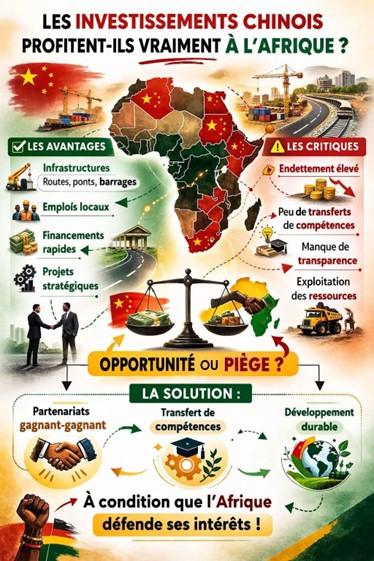
In parallel, these investments have contributed to the creation of local jobs and the improvement of certain productive capacities. For many African states, they represent a concrete opportunity to accelerate their development.
However, this dynamic is accompanied by growing criticism. One of the main concerns relates to debt: some countries find themselves heavily exposed to Chinese debt, which can weaken their economic sovereignty. Added to this are concerns related to the lack of skills transfer, limiting the long-term impact on local economies.
The issue of contract transparency is also regularly raised, as is that of natural resource exploitation, sometimes perceived as unbalanced in favor of foreign partners. These factors fuel the debate on the true nature of these investments.
Therefore, the central question is not simply whether Chinese investments benefit Africa, but rather under what conditions they can truly be beneficial. The challenge is to build balanced partnerships where African interests are fully taken into account.
This implies that African states must strengthen their negotiating power, demand local benefits in terms of training and industrialization, and integrate these projects into long-term development strategies. Transforming these investments into drivers of sustainable development will depend largely on this ability to guide and structure collaborations.
Thus, Chinese investments are neither inherently an opportunity nor a trap. They represent a powerful tool, the impact of which depends on the strategic choices made by African countries themselves. The challenge, therefore, is not simply to attract capital, but to use it as a lever for sovereignty and economic transformation.
