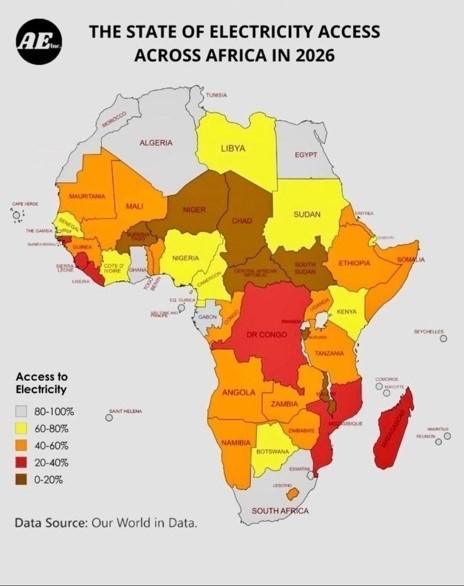
Access to electricity remains one of the main structural challenges to development in Africa, but also one of its greatest economic opportunities. A significant portion of the continent’s population still lacks reliable access to energy, which considerably hinders growth potential. This reality highlights a fundamental link: without energy, there can be no large-scale development.
The lack of stable access to electricity limits the capacity of economies to transform. Without energy, industries cannot operate efficiently, businesses struggle to grow, and technological innovations remain difficult to implement. This constraint translates into low productivity, limited job creation, and slower economic growth. Energy thus appears not as just another sector, but as the foundation upon which all economic activity rests.
However, behind this challenge lies considerable potential. Regions where access to electricity remains limited also represent significant opportunities for investors, governments, and development actors. The energy deficit means there is substantial, largely unmet demand that could be addressed by innovative solutions tailored to local realities.
Africa has significant assets to meet this challenge. The continent possesses exceptional potential in renewable energies, particularly solar, wind, and hydropower. In many areas, these resources could enable the development of decentralized energy systems that are more flexible and accessible. These solutions offer an alternative to traditional models, which are often expensive and difficult to deploy on a large scale.
Developing energy infrastructure is therefore a strategic priority. Investing in electricity generation, transmission, and distribution would not only improve living conditions but also stimulate industrialization and innovation. Reliable energy is essential to attracting investment, developing local businesses, and further integrating the continent into global value chains.
Furthermore, electrification can play a key role in social transformation. Access to energy facilitates education, improves healthcare services, and fosters the emergence of new economic activities, particularly in rural areas. It thus contributes to reducing inequalities and strengthening social cohesion.
In this context, the question is no longer whether Africa will be electrified, but how and by whom this transformation will be led. Governments, private investors, and international partners are called upon to play a decisive role in this transition. The ability to mobilize financing, implement appropriate policies, and foster innovation will be essential to accelerating this process.
Energy is the foundation of African economic development. Bridging the electricity access gap is not just a challenge, but a unique opportunity for transformation. By investing in this key sector, Africa can lay the groundwork for sustainable, inclusive, and large-scale growth, and establish itself as a major player in tomorrow’s global economy.