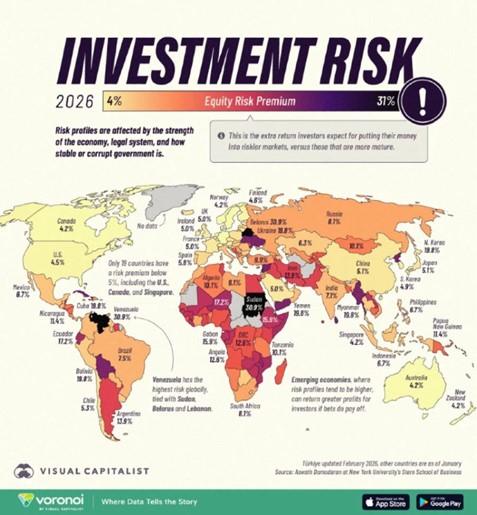
Global risk maps, often used by investors to guide their decisions, are not as neutral as they appear. Behind their apparent objectivity lies a deeply entrenched logic: they tend to favor rapid extraction activities while penalizing industrial transformation projects. This reality profoundly influences how international capital is allocated, particularly in Africa.
The African continent is frequently perceived as “too risky” when it comes to investing in high-value sectors such as manufacturing, local processing, or logistics infrastructure. Yet, this same continent continues to attract significant investment in extractive sectors, particularly mining, oil, and export hubs. This paradox reveals a marked market preference for economic models based on the rapid exploitation of natural resources.
Indeed, investors generally favor projects offering quick and secure returns. Natural resource extraction perfectly meets these criteria: it allows for exports in hard currency, short investment cycles, and relatively predictable capital outflows. This model, while profitable in the short term, nevertheless limits local economic benefits and hinders the development of integrated value chains.
Conversely, investments in industrial transformation—whether it involves building factories, developing regional value chains, or strengthening local production capacity—are often perceived as riskier. They require patient capital, robust infrastructure, regulatory stability, and a long-term vision. These elements, while essential for sustainable development, are still undervalued by international financial markets.
Yet, it is precisely in these areas that Africa’s true growth potential lies. Developing local industry would allow it to capture a greater share of added value, create skilled jobs, and strengthen economic resilience. Furthermore, building robust domestic markets and regional value chains could reduce dependence on raw material exports and foster more inclusive growth.
Africa doesn’t need to demonstrate that extracting its resources is profitable: current investment flows already prove it. The real challenge now is to make industrial transformation “bankable,” that is, attractive enough to mobilize large-scale financing. This implies rethinking investment frameworks, reducing perceived risks, and implementing public policies that support industrialization.
When this transformation takes place on a large scale, it could profoundly alter the economic balance. By addressing its industrial deficits, Africa will no longer be merely a supplier of raw materials, but will become a key player in global value chains. This shift could reverse current trends and reposition the continent at the heart of the global economy.
Risk maps are not static. They reflect perceptions that can evolve over time and with the policies implemented. For Africa, the challenge is clear: to transform these perceptions into opportunities by demonstrating that industrialization is not only necessary but also profitable. Much of the continent’s economic future hinges on this transition.