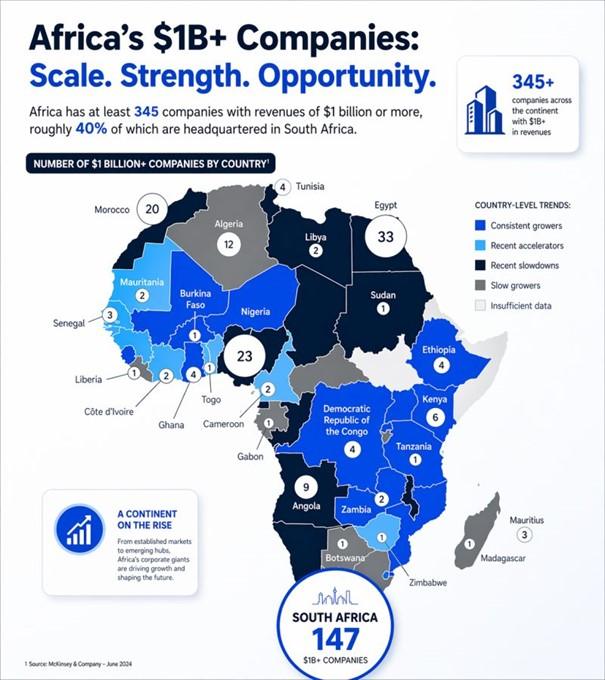
Contrary to a still widespread misconception, Africa can no longer be considered an “emerging” market in the traditional sense. In many sectors, it is already structured, organized, and competitive. The figures speak for themselves: more than 345 companies on the continent each generate over one billion dollars in annual revenue. This reality testifies to a robust economic fabric and players capable of competing on an international scale.
However, this economic power is not evenly distributed. Approximately 40% of these large companies are concentrated in a single country, South Africa, which alone has 147. It is followed by Egypt with 33 companies, Nigeria with 23 and Morocco with 20. These countries constitute true regional economic hubs, with relatively developed infrastructure, structured markets and a more mature business environment than in other regions of the continent.
This concentration highlights a key characteristic of the African economy: it is not a single market, but a network of economic hubs at varying levels of development. Each country, and even each region, has its own dynamics, opportunities, and constraints. Disparities in economic maturity, regulations, and purchasing power create a complex environment where value is concentrated and competition is already well established.
In this context, barriers to entry are often underestimated. Access to the African market is not solely based on strategic vision or strong ambition. It requires a nuanced understanding of local realities, adaptability, and above all, rigorous execution.
Successful companies are those that manage to establish effective distribution networks, control their operations, and maintain close relationships with their customers.
The key to success lies in execution. Simply being the first to enter a market is no longer enough to guarantee a lasting presence. The new leaders will be those who can optimize their supply chains, understand specific consumer needs, and quickly adapt their strategies to evolving market conditions. Operational performance thus becomes a determining factor in competitiveness.
Consequently, Africa today is a demanding economic space, where opportunities are real but require a structured and pragmatic approach. Far from the clichés of a continent in development, it is emerging as a collection of dynamic, interconnected, and already competitive markets. To succeed there, businesses will need to move beyond preconceived notions and prioritize a strategy based on precision, rigor, and excellence in execution.