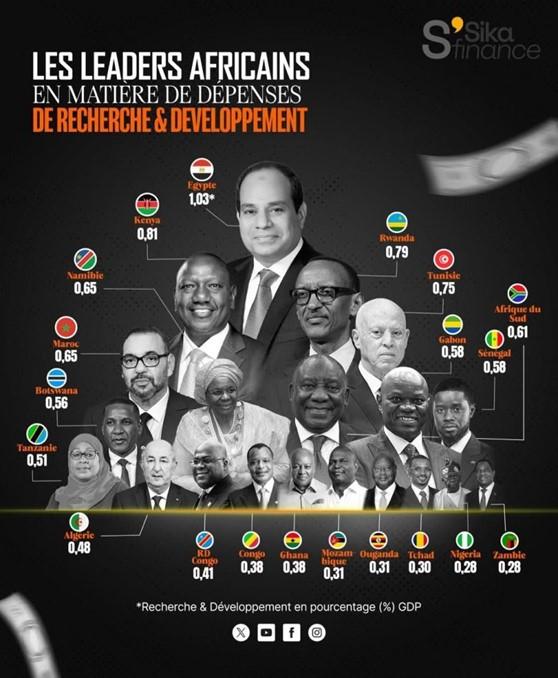
In a world where knowledge and innovation determine national competitiveness, research and development (R&D) is a fundamental pillar of sustainable growth. In Africa, although investments in this area reach approximately $34.78 billion, they remain concentrated in a limited number of countries and are insufficient on a continental scale. This situation reveals a paradox: growing economies that are still largely uncommitted to building a robust scientific ecosystem.
Egypt dominates R&D spending with over $16 billion, followed at a distance by countries like South Africa and Nigeria. This concentration of investment underscores significant disparities between African economies. Globally, the continent remains marginal in terms of scientific output and innovation, which limits its ability to influence major technological transformations.
Within the West African Economic and Monetary Union (WAEMU), the situation clearly illustrates these contrasts. Senegal devotes approximately 0.58% of its GDP to R&D, while Burkina Faso reaches 0.25%, Togo 0.19%, and Côte d’Ivoire only 0.07%. These levels remain low compared to international standards, where the most innovative economies often invest more than 2% of their GDP in research.
This lack of investment in R&D poses a major challenge to the continent’s development. Contrary to a sometimes widespread perception, research is not a luxury reserved for advanced economies. On the contrary, it is a crucial driver of innovation, productivity improvements, industrial transformation, and long-term competitiveness. Without a structured commitment to this area, African economies risk remaining dependent on technologies and innovations developed elsewhere.
The real challenge for regions like the WAEMU is to shift from a growth model based primarily on resources and consumption to one based on knowledge and innovation. This transition requires ambitious public policies capable of making R&D a strategic priority. It also involves strengthening ties between universities and businesses to transform research findings into concrete applications and solutions tailored to local needs.
Furthermore, the establishment of dedicated funding mechanisms is essential to support research projects and encourage innovation. This requires mobilizing public resources, but also involving the private sector, which is still too under-engaged in this area. Promoting local research, which is often underutilized, is also a key lever for strengthening the economic impact of R&D.
Africa has no shortage of potential. It possesses talent, resources, and a dynamic youth capable of driving innovation. The real challenge lies in the ability to invest strategically in knowledge. By strengthening its research and development efforts, the continent can not only accelerate its economic transformation but also establish itself as a credible player in the global knowledge economy.