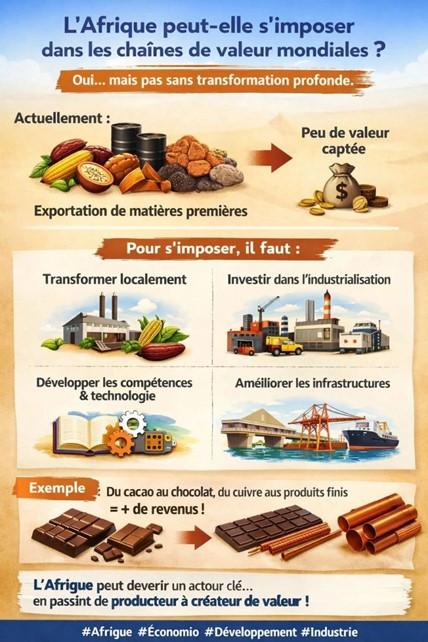
Africa possesses abundant resources, a young population, and a strategic location that could make it a major player in global value chains. Yet, despite these advantages, the continent still captures a limited share of the value generated by its own wealth. The main reason is well-known: an economy still largely geared towards exporting raw materials, to the detriment of their local processing.
Today, many African products—from minerals and agricultural goods to energy resources—are exported unprocessed. This significantly limits the economic benefits for producing countries. By selling at low value-added levels and importing finished products at higher prices, Africa finds itself at a disadvantage within global value chains.
To reverse this trend, a profound transformation is necessary. The first lever lies in the local processing of resources. Producing cocoa is no longer enough: it is now essential to develop industries capable of transforming it into chocolate, thereby capturing a much larger share of the value. Similarly, transforming copper into industrial components or finished products would multiply revenues and strengthen industrialization.
Industrial development is therefore a strategic priority. Investing in production infrastructure, supporting local businesses, and encouraging innovation are essential steps in building a solid industrial base. This transition would not only create jobs but also diversify African economies, making them less dependent on fluctuations in commodity markets.
At the same time, skills development and access to technology play a crucial role. A skilled workforce is essential to support modern and competitive industries. This requires massive investments in education, vocational training, and research to prepare future generations for the demands of a constantly evolving global economy.
Infrastructure and logistics constitute another fundamental pillar. Efficient transport networks, modernized ports, and high-performing logistics systems are necessary to facilitate the production and export of processed goods. Without these elements, even the best industrial strategies risk remaining limited in their impact.
Finally, regional integration can play a key role in this transformation. By strengthening trade between African countries and developing regional value chains, the continent can create a larger and more attractive market for investors. Initiatives like the African Continental Free Trade Area (AfCFTA) offer a unique opportunity to structure these dynamics on a large scale.
In conclusion, Africa possesses all the necessary elements to establish itself in global value chains. However, this potential can only be realized through an ambitious and coordinated transformation. The real challenge lies in shifting from a model based on extraction to one founded on value creation. The continent’s economic future and its capacity to become a key player in the global economy hinge on this transition.