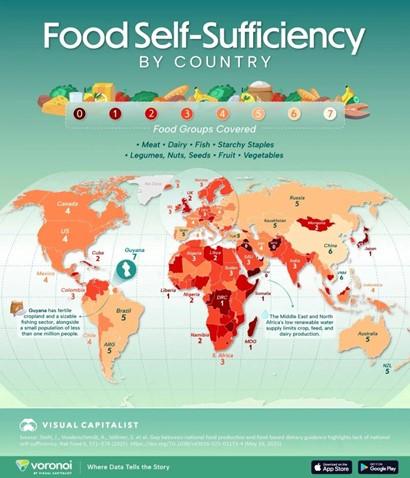
At the crossroads of agricultural, economic, and geopolitical issues, the question of food sovereignty has emerged as a major challenge for the Middle East and North Africa (MENA) region, as well as for sub-Saharan Africa. Despite significant financial resources for some countries and exceptional agricultural potential for others, these regions remain heavily dependent on food imports. This paradox highlights a strategic reality: food security is not only a matter of wealth, but also of infrastructure, policies, and targeted investments.
In the Gulf Cooperation Council (GCC) countries, dependence on food imports has reached critical levels, with approximately 85% of food products coming from abroad. This dependence affects both staples, such as bread, and protein sources. Across the MENA region, nearly 40% of daily calories consumed come from imported grains. This situation exposes these countries to significant risks in the event of disruptions to global supply chains.
The crisis linked to the 2022 war between Russia and Ukraine starkly illustrated this vulnerability. At that time, approximately 36% of the MENA region’s wheat imports originated from this strategic corridor. A single conflict, affecting a key trade route, was enough to expose nearly 400 million people to a potential food crisis. Countries like Egypt, Lebanon, and Tunisia thus realized that their food security rested on fragile balances. More than a one-off crisis, this episode served as a wake-up call regarding the systemic risks associated with excessive dependence on imports.
Faced with this reality, a crucial question arises: can wealth guarantee food sovereignty? The facts suggest that the answer is nuanced. While financial resources may allow for the purchase of food on international markets, they do not protect against geopolitical shocks, logistical disruptions, or price volatility. True food sovereignty requires local production capacity, resilient supply chains, and appropriate infrastructure.
This is where Africa plays a central role in the equation. The continent holds approximately 60% of the world’s uncultivated arable land, nearly 874 million hectares. Yet, it continues to spend around $78 billion annually importing food that it could, for the most part, produce locally. Even more paradoxically, nearly 307 million Africans suffered from undernourishment in 2024, on a continent with the world’s greatest agricultural potential.
This contrast highlights a structural deficit in agricultural infrastructure, logistics, processing, and financing. This is not simply a development problem, but a major investment opportunity. The existing gap in food infrastructure between Africa and the MEASA region (Middle East, Africa, and South Asia) represents one of the greatest economic opportunities of the decade.
Investing in African agriculture, local value chains, and distribution systems could not only reduce food dependency but also create millions of jobs, stimulate economic growth, and strengthen regional resilience. Strategic partnerships between capital-rich Gulf states and land-rich African countries could thus redefine global food balances.
Finally, food sovereignty is not limited to access to financial resources. It rests on a long-term vision, strategic investments, and intelligent regional cooperation. In this context, Africa and the MENA region are not facing a crisis, but a historic opportunity: to transform a structural imbalance into an engine of sustainable growth and food security for future generations.