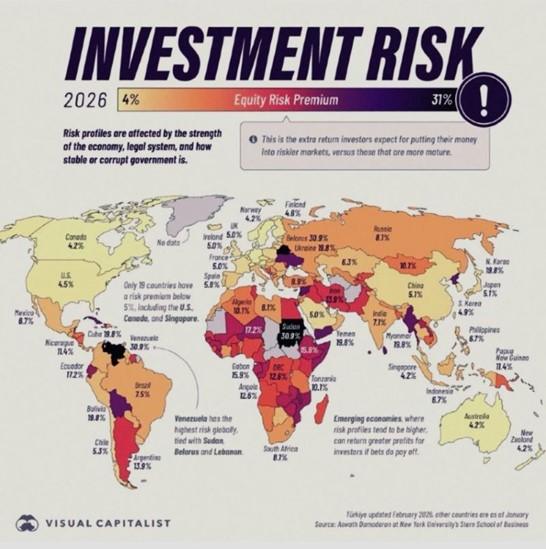
In a globalized world where investment flows constantly between regions, not all markets present the same risk profile. Yet, far from being an obstacle, risk can become a powerful lever for value creation. The concept of a “risk premium”—which corresponds to the additional return investors demand to compensate for uncertainty—perfectly illustrates this reality: the riskier a market, the higher its potential return.
Thus, countries considered unstable or emerging often offer higher earning potential than developed economies. Emerging markets, for example, generally exhibit higher risk premiums, reflecting economic, political, or monetary uncertainties, but also significant growth opportunities.
Several factors shape this risk landscape. Economic strength is a key element: advanced economies like the United States and Germany attract stable investment, while developing countries like India and Brazil offer the potential for rapid but more uncertain growth. Political stability also plays a crucial role: strong institutional environments reassure investors, while unstable contexts increase risk—and therefore potential returns.
The legal and regulatory framework is another essential pillar. Robust legal systems, such as Singapore’s, encourage foreign investment, while weaker frameworks can hinder capital flows due to a lack of investor protection. Finally, currency dynamics strongly influence investment decisions: a stable currency attracts capital, whereas inflation and volatility can be both a deterrent and an opportunity for more experienced investors.
The relationship between risk and return is central to any financial strategy. Low-risk markets generally offer greater stability and predictability, but with limited returns. Conversely, high-risk markets can generate significantly higher returns, sometimes exceeding 10%, provided the associated risks are managed effectively. This logic rests on a fundamental principle: risk is not to be avoided, but rather understood, measured, and integrated into an overall strategy.
For investors, the key lies in diversification. A balanced allocation—combining stable and emerging markets—maximizes returns while limiting exposure to shocks. This strategic approach transforms uncertainty into a competitive advantage by capitalizing on performance differences between regions.
For high-risk countries, the challenge is different but just as strategic. To attract sustainable investment, several levers can be activated. Strengthening political and institutional stability is essential to building confidence. Improving legal frameworks helps secure investments and reduce uncertainty. Economic diversification is also a key factor in limiting dependence on a single sector and building resilience. Finally, infrastructure development—particularly in transport, energy, and digital technologies—plays a central role in economic attractiveness.
Risk should not be seen as a constraint, but as a strategic opportunity. Wise investors do not seek to avoid it, but to capitalize on it. For their part, high-risk countries have the capacity to transform their challenges into drivers of growth, provided they adopt appropriate policies. In a constantly evolving world, the real question is not the existence of risk, but how it is understood, managed, and exploited.