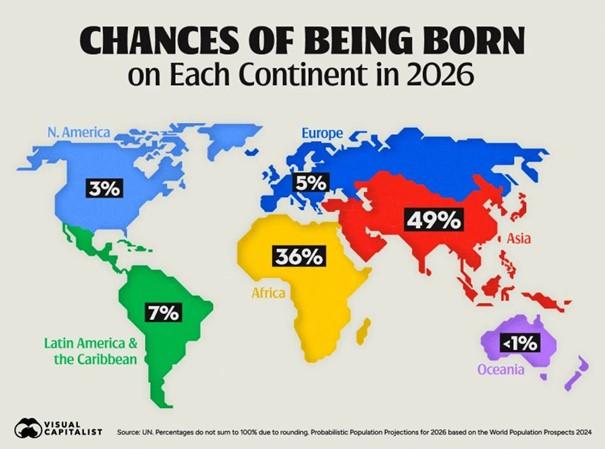
By 2026, a major demographic reality will emerge globally: more than one in three babies will be born in Africa. According to United Nations projections, the continent alone will account for nearly 36% of global births that year. Adding Asia to this figure, these two regions will concentrate approximately 85% of births worldwide. These figures illustrate a profound shift in the global demographic center of gravity and underscore a clear fact: Africa is where much of humanity’s future is being built.
This dynamic can be explained by several factors, including still-high fertility rates in many African countries and a generally young population. Unlike other regions of the world facing aging and declining birth rates, Africa stands out for its sustained population growth. This situation represents considerable potential, but also a major responsibility, both for African governments and the international community.
Indeed, this growing youth population represents a unique opportunity for economic and social development. A young, well-educated, and healthy population can become a powerful engine of growth, innovation, and transformation. However, for this potential to be realized, massive and strategic investments are essential, particularly in education, health, and skills development.
African education systems will need to be able to accommodate a growing number of students and provide them with quality training tailored to the demands of tomorrow’s job market. Similarly, healthcare infrastructure must be strengthened to ensure equitable access to care, reduce infant mortality, and improve living conditions. Furthermore, skills development, particularly in the technology and industrial sectors, will be crucial for effectively integrating this new generation into the global economy.
Beyond the continent’s borders, the stakes are also global. How Africa addresses these challenges will have direct repercussions on the economic, social, and political stability of the entire world. A well-supported youth can contribute to global prosperity, while insufficient investment could exacerbate inequality, tensions, and migration flows.
Therefore, a crucial question arises: are we investing early enough and adequately in the foundations on which this generation will depend? The answer to this question will largely determine the future trajectory not only of Africa, but also of the world as a whole.
Africa’s demographic surge represents a historic turning point. It calls for a long-term vision, based on foresight, cooperation, and commitment. Investing in African youth today means investing in the balance and prosperity of tomorrow’s world.