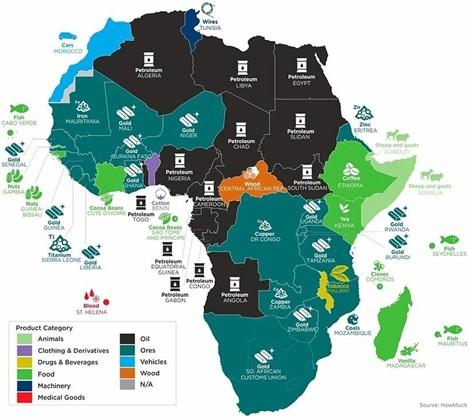
Africa possesses considerable economic potential, but it still faces a structural paradox: it consumes more than it produces and exports its resources massively without fully capturing their value. Despite having some of the most fertile arable land in the world and abundant natural resources, the continent remains heavily dependent on imports, particularly for processed and industrial goods.
Today, approximately 95% of the resources extracted in Africa are exported in their raw state. Whether it’s cocoa, gold, coffee, diamonds, cobalt, lithium, or copper, the majority of these products leave the continent without significant processing. This situation leads to a major economic imbalance: Africa sells its raw materials at low added value and then imports finished products at much higher prices. This model limits local wealth creation, hinders industrialization, and perpetuates dependence on external markets.
In 2025, African exports reached approximately $615 billion, confirming an upward trend. However, their composition remains largely dominated by three major sectors: energy and oil (approximately $280 billion), minerals and precious metals ($145 billion), and agriculture ($85 billion). This concentration underscores the continent’s continued dependence on extractive industries and primary commodities.
Some countries stand out due to their significant economic weight in exports. South Africa leads the way with approximately $145 billion in exports, followed by Nigeria ($133 billion), Algeria ($105 billion), Morocco ($93 billion), and Egypt ($77 billion). These economies play a central role in African trade, but they also illustrate the diversity of economic models across the continent.
Despite this observation, signs of change are emerging. A slight increase in processed products, such as refined petroleum, indicates the beginnings of diversification. However, these advances remain limited compared to the vast untapped potential.
One of the major drivers of transformation lies in Africa’s capacity to develop its industrial sector. The continent possesses unique assets to become a competitive production platform, particularly in technology industries and global value chains. The combination of a young, abundant, and rapidly growing workforce—with two-thirds of the world’s youth expected to be African in the coming decades—and strategic natural resources creates an environment conducive to accelerated industrialization.
To realize this potential, several conditions must be met. Investing in infrastructure, strengthening local processing capacity, and fostering a business-friendly environment are essential. The development of regional value chains, supported by initiatives such as the African Continental Free Trade Area (AfCFTA), could also play a crucial role by facilitating trade and boosting local production.
Ultimately, Africa is at a pivotal moment in its economic development. The current model, based on the export of raw materials, is showing its limitations. The continent’s future will depend on its ability to transform its resources into high-value-added products and fully integrate into global production chains. By shifting from an extractive economy to a processing economy, Africa can not only reduce its dependence but also establish itself as a major industrial player in the 21st century.