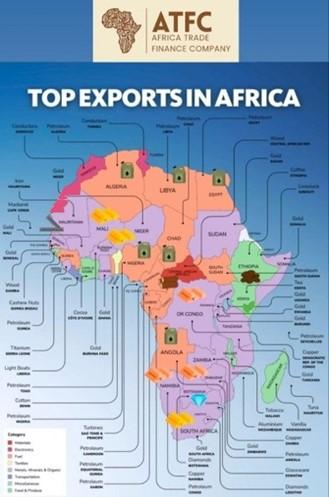
When discussing African exports, the term “raw materials” often comes up almost automatically. However, a deeper analysis reveals a far more complex and promising reality. Africa does not simply export raw resources; it is now a key pillar of many global industries and is embarking on a transition towards higher value-added activities.
Across the continent, exports are estimated at around $615 billion for the period 2025-2026, of which nearly $280 billion comes from the energy and oil sector. While these figures confirm the historical importance of natural resources, they do not fully reflect the ongoing transformation. Increasingly, Africa is integrating itself into industrial and technological value chains, thereby expanding its role in the global economy.
The energy and technology sector perfectly illustrates this evolution. Beyond hydrocarbons, African countries now export strategic minerals essential to the global energy transition. Titanium from Sierra Leone, copper from Zambia and Namibia, and advanced conductors produced in Morocco and Tunisia supply the electronics industry, power grids, and clean technologies. These resources are central to current industrial transformations, placing Africa in a strategic position.
At the same time, the continent remains a global leader in luxury goods and precious resources. South Africa and Botswana, for example, continue to play a major role in gold and diamond production, contributing to high-value markets and international recognition.
Africa also stands out as a key player in the food and agricultural industries. Iconic products such as cocoa from Côte d’Ivoire, coffee from Ethiopia, and vanilla from Madagascar supply global production chains in the food, beverage, and fragrance sectors. This often-underestimated contribution positions the continent as a vital supplier to international markets.
African exports also contribute to the development of global infrastructure. Iron from Mauritania and timber from the Central African Republic are used in the construction of cities and infrastructure projects around the world, supporting the rapid urbanization observed globally.
However, the most significant transformation lies in the emergence of specialized and manufactured products. Unexpected sectors are gaining momentum, such as the production of small boats in Liberia or glassware in Eswatini. These examples demonstrate the increasing diversification of the “Made in Africa” label, which is becoming more sophisticated and competitive.
The map of African exports should no longer be seen as a simple representation of natural resources, but as a true map of strategic opportunities. The continent is gradually evolving towards more complex value chains, integrating local processing, innovation, and industrialization.
Thus, the future of global trade will not be determined solely by access to raw materials, but also by economies’ ability to create value from these resources. Africa, undergoing rapid transformation, has all the assets to play a central role in this new dynamic. By developing its industrial capacity and strengthening its value chains, it can transform its potential into sustainable economic power and establish itself as a key player in tomorrow’s global economy.