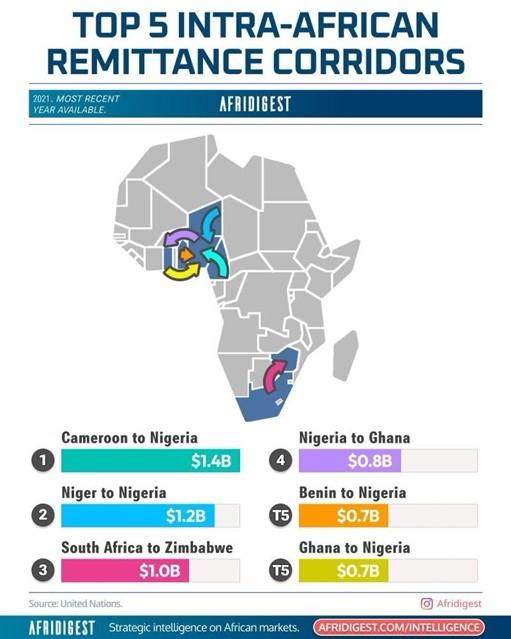
Money transfer flows in Africa are not limited to exchanges between the continent and the rest of the world. Increasingly, intra-African dynamics are gaining momentum, revealing a regional financial network in full development. Each year, more than $19 billion circulates between African countries in the form of remittances, representing a major opportunity for financial institutions and fintech players.
At the heart of these flows, certain corridors stand out due to their volume and strategic importance. The most significant of these connects Cameroon to Nigeria, illustrating the particularly close economic and human ties between these two countries. Other major routes include transfers from Niger to Nigeria, from South Africa to Zimbabwe, as well as flows between Nigeria and Ghana, in both directions. The corridor between Benin and Nigeria is also among the most active, confirming the latter’s central role in regional financial exchanges.
Nigeria has emerged as the primary hub for intra-African remittances. Not only is it a major destination for remittances from abroad—particularly from the United States and the United Kingdom—but it also plays a dominant role in flows within the continent. This position is explained by the size of its economy, its demographic weight, and the importance of its diaspora, both regionally and internationally.
One particularly noteworthy element is Cameroon’s position within this system. Although not among the continent’s largest economies, it is the third-largest source of remittances to Nigeria, after the United States and the United Kingdom. This fact underscores the importance of informal economic exchanges and regional migration in shaping African financial flows.
Faced with this dynamic, financial sector players are intensifying their efforts to capture this rapidly growing market. Fintechs, in particular, are playing an increasingly central role by offering faster, cheaper, and more accessible money transfer solutions. Companies like the Tanzanian fintech NALA and the international platform Wise have recently obtained money transfer operator licenses from the Central Bank of Nigeria, a sign of the market’s growing attractiveness.
These developments reflect a broader transformation of African financial systems. Intra-African remittances are no longer simply a source of support for households, but are becoming a driver of regional economic integration. They facilitate trade, support small businesses, and strengthen ties between national economies.
However, challenges remain, particularly regarding transaction costs, regulation, and financial inclusion. Despite technological advances, remittances in Africa remain among the most expensive in the world, limiting their potential impact. Improved coordination between countries and a harmonized regulatory framework could help reduce these costs and further stimulate remittance flows.
Ultimately, intra-African transfer corridors represent far more than a simple movement of capital. They constitute a vital pillar of the continent’s economic integration and a strategic opportunity for financial actors. As technologies evolve and markets become more structured, these flows could play a decisive role in building a more connected, more inclusive, and more economically integrated Africa.