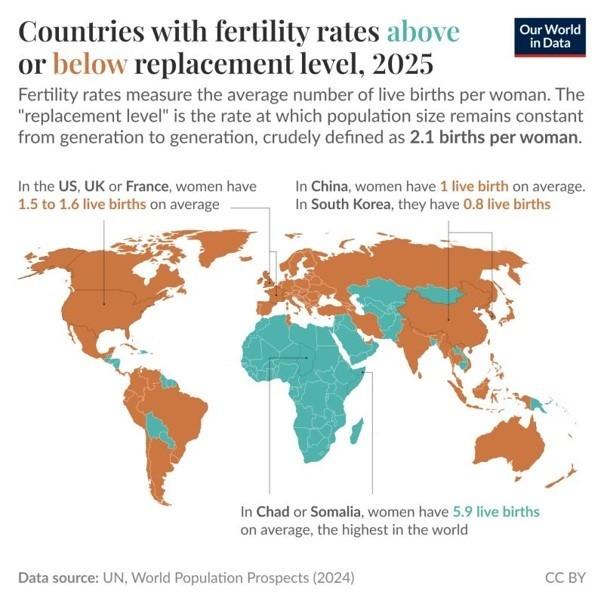
For several decades, global demographic dynamics have been undergoing profound transformation. One of the most revealing indicators of this evolution is the fertility rate, which measures the average number of children per woman. Globally, this rate has declined dramatically, from approximately 5 children per woman in 1950 to nearly 2.2 today. This rapid decrease reflects major changes in lifestyles, public policies, access to education, and the role of women in societies.
This downward trend has direct consequences for population growth. While the world’s population increased significantly during the 20th century, its growth rate is now slowing considerably. According to United Nations projections, many countries could even see their populations decline by the end of the century. This phenomenon is mainly explained by the fact that fertility rates are now, in many cases, below the so-called “replacement” level.
The replacement level is the fertility rate necessary for a population to maintain itself from one generation to the next without migration. It is generally estimated at 2.1 children per woman. When the fertility rate falls below this level, the population tends to decline in the long term, unless this decline is offset by significant immigration.
By 2025, according to United Nations projections (World Population Prospects), much of the world will already be below this critical level. This is particularly true for many countries in Europe, East Asia, and North America, where fertility rates are often well below 2.1. In these regions, population aging is becoming a major issue, with significant economic and social implications: increased pressure on pension systems, a shrinking working-age population, and transformations in family structures.
Conversely, several countries, primarily located in sub-Saharan Africa, maintain fertility rates above the replacement level. These countries continue to experience strong population growth, driven by a young and expanding population. This situation presents both an opportunity—in terms of potential economic dynamism—and a challenge, particularly regarding education, employment, and access to basic services.
The geographical distribution of fertility rates thus highlights a demographically fragmented world. On one hand, societies are facing decline and aging; on the other, regions are experiencing rapid population growth. This duality raises essential questions for the future: how can public policies be adapted to these contrasting realities? How can economic growth, human development, and social stability be balanced?
That said, the overall decline in fertility rates marks a major demographic transition. It is reshaping global balances and forcing states to rethink their long-term strategies. In a world where more and more countries are falling below the replacement level, the demographic question is becoming a central issue of the 21st century.