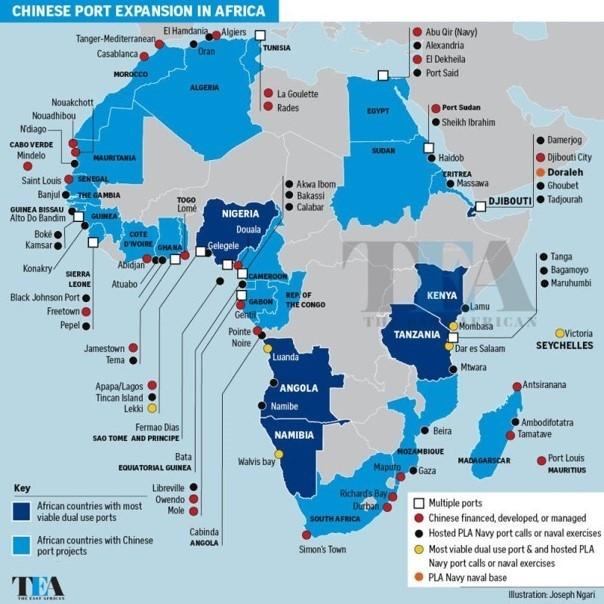
Over the past few decades, China’s economic presence in Africa has intensified remarkably, particularly through massive investments in port infrastructure. Behind this dynamic lies a broader strategy, intertwining economic, geopolitical, and security considerations. By focusing on the development of African ports, Beijing is not simply supporting the continent’s growth; it is also consolidating its long-term influence over strategic maritime routes.
Ports are essential infrastructure for international trade. In Africa, their modernization has become a priority in order to facilitate trade, reduce logistics costs, and strengthen regional integration. China, through its companies and financial resources, has positioned itself as a key partner in this area. Numerous projects have been launched, increasing capacity, improving facilities, and connecting ports to rail and road networks.
However, these investments are not solely driven by economic considerations. They are part of a strategic vision where “infrastructure today” could become “influence tomorrow” and, potentially, a more assertive lever of power in the future. By controlling or participating in the management of key ports, China is strengthening its presence at critical points in global maritime trade. This gradual expansion allows it to secure its supply routes, particularly for natural resources, while consolidating its position in international logistics chains.
African coastlines, particularly those of the Indian and Atlantic Oceans, are thus taking on increasing geopolitical importance. Once perceived as relatively neutral spaces, they are now becoming strategic hubs at the heart of power struggles between major nations. The Chinese presence in these areas could ultimately alter regional balances, introducing new dynamics of both cooperation and competition.
For African countries, these investments represent both an opportunity and a challenge. On the one hand, they enable the modernization of crucial infrastructure and stimulate trade, thus contributing to economic development. On the other hand, they raise questions about sovereignty, financial dependence, and control of strategic assets. Managing these partnerships therefore requires a balanced approach, capable of maximizing benefits while safeguarding national interests.
In conclusion, China’s port strategy in Africa illustrates a new form of economic diplomacy, where infrastructure becomes an instrument of lasting influence. As African ports transform into major logistics hubs, they also become part of a changing power dynamic. The challenge for Africa will be to fully capitalize on these investments while asserting its place in an increasingly competitive and interconnected international system.