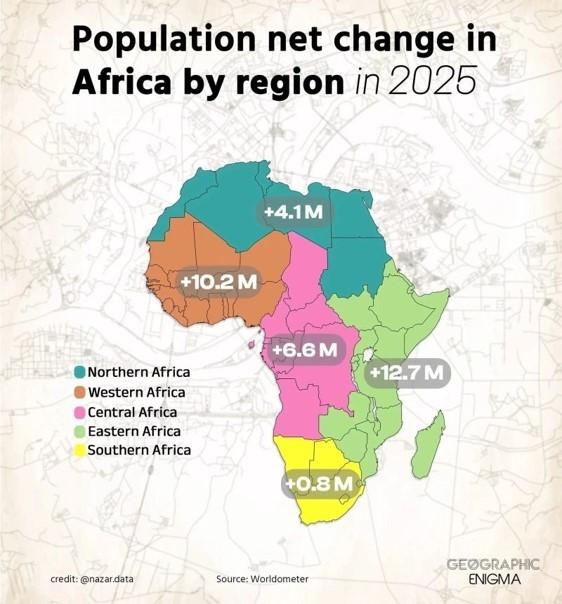
By 2025, Africa will confirm its central role in global population growth, but this dynamic will not unfold uniformly across the continent. Different African regions will evolve at distinct rates, revealing contrasting economic, social, and demographic realities.
East Africa stands out as one of the main drivers of this expansion. In a single year, its population increased by nearly 13 million people, fueled by high birth rates and a predominantly young population. This rapid growth reflects considerable potential, but it also poses significant challenges in terms of infrastructure, education, and employment. The ability of countries in this region to transform this demographic momentum into an economic advantage will largely depend on their capacity to invest in human capital and create opportunities.
West Africa is following a similar trajectory, with an increase of more than 10 million inhabitants by 2025. This region has experienced sustained population growth for several decades, fueled by comparable factors: high fertility rates and a young population. Countries like Nigeria, Ghana, and Senegal play a key role in this growth, helping to make West Africa one of the continent’s major demographic hubs.
Central Africa, for its part, is also experiencing rapid growth, although it often receives less media attention. The dynamics there are comparable, with a rapidly increasing population and similar development challenges. This region, rich in natural resources, could capitalize on its population growth provided it strengthens its infrastructure and governance.
Conversely, North Africa is experiencing more moderate and relatively stable growth. Birth rates are gradually declining, and demographic transitions are more advanced. This trend translates into a more controlled rate of population increase, accompanied by economic and social transformations that differ from those observed south of the Sahara.
Finally, Southern Africa has the lowest population growth on the continent. Population increases there are relatively limited, due to lower fertility rates and demographic trends more similar to those of middle-income economies. This situation reflects a more advanced demographic transition, but also poses other challenges, particularly related to the gradual aging of the population.
Globally, these dynamics confirm that Africa will remain the main driver of global population growth in the coming decades. Much of this expansion will be concentrated in East and West Africa, where populations will continue to grow rapidly.
However, this growth is not an end in itself. It represents both an opportunity and a major challenge. If accompanied by appropriate policies—particularly in education, health, industrialization, and job creation—it can become a powerful driver of development. Otherwise, it risks exacerbating economic and social inequalities.
African population growth is a complex and multifaceted reality. Understanding its regional dynamics is essential to anticipating future needs and developing appropriate strategies. In a changing world, Africa, with its growing demographic weight, will play a decisive role in shaping the global balance of the 21st century.