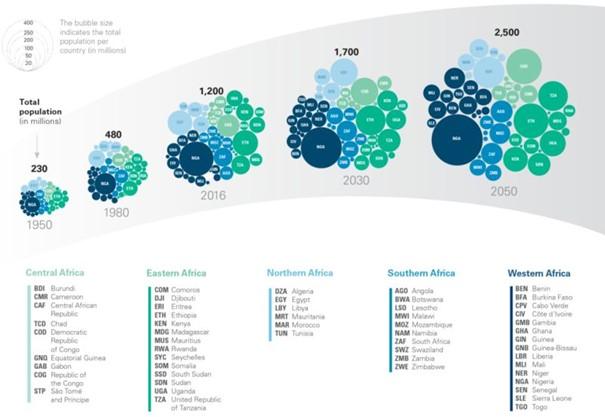
Africa is no longer simply an “emerging” continent; it is now experiencing explosive growth. Demographic figures clearly illustrate this transformation. From 230 million inhabitants in 1950, Africa’s population rose to 480 million in 1980, and then to 1.2 billion in 2016. Projections indicate that it will reach approximately 1.7 billion by 2030 and nearly 2.5 billion by 2050. In barely three decades, more than 1.3 billion additional people will be added to the continent’s population. This is no longer linear growth, but a truly exponential expansion.
This dynamic is driven by several key countries. Nigeria is steadily emerging as one of the most populous nations in the world, while Ethiopia, the Democratic Republic of the Congo, and Tanzania are experiencing rapid demographic growth. At the same time, economies such as Kenya, Ghana, and Senegal stand out for their accelerated urbanization, increasing connectivity, and rapid adoption of digital technologies.
Africa today is a continent under construction, where new cities are emerging in real time. This rapid urbanization is accompanied by the rise of an expanding middle class and a deeply connected generation. Unlike traditional development models, this new generation is “mobile-first,” meaning it accesses digital services directly through mobile phones, bypassing traditional infrastructures such as personal computers.
However, Africa’s true uniqueness lies in the speed of its transformation. Growth is measured not only in terms of population, but also in terms of pace. The continent is now among the fastest-growing regions in urbanization, mobile penetration, and digital service development. The fintech sector, for example, is experiencing remarkable expansion, with innovative solutions that bypass the limitations of traditional banking systems.
Economic opportunities are numerous. The mobility sector, still largely underdeveloped, offers considerable potential. Energy, logistics, artificial intelligence, and digital platforms also represent new investment frontiers. At a time when many global markets are approaching saturation, Africa appears as a largely untapped space for growth.
This rapid transformation is also changing the way investors and businesses must approach the continent. The question is no longer why invest in Africa, but how quickly one can establish a presence there. Growth cycles are faster, markets evolve continuously, and opportunities can emerge and transform within a very short period of time.
Thus, Africa embodies a new phase of global development, characterized by a unique combination of demographic growth, technological innovation, and economic transformation. For economic actors, the challenge is no longer understanding the continent’s potential, but adapting to its pace. In a constantly evolving environment, those who can act quickly and effectively will be best positioned to benefit from this exceptional momentum.