With a population now exceeding 1.5 billion, Africa is gradually establishing itself as one of the world’s most promising markets. Beyond its demographic size, the continent is distinguished by the rapid emergence of a middle class estimated at between 340 and 400 million consumers, of whom approximately 220 million belong to a high-purchasing-power category. This consumer base alone surpasses the total population of some large countries like Brazil, illustrating the scale of Africa’s economic potential.
This dynamic is reinforced by the strategic role of five major economies, often referred to as the “Power Five”: Egypt, Nigeria, South Africa, Morocco, and Algeria. Together, these countries represent a market of over 480 million people and a combined gross domestic product of approximately $1.5 trillion in 2023. These economic hubs structure a large part of the continent’s activity and attract a significant share of international investment.
The African entrepreneurial landscape is also booming. Today, there are at least 345 companies, each generating over $1 billion in revenue, for a combined total exceeding $1 trillion. Nearly 40% of these companies are based in South Africa, confirming the country’s central role in the continental economy. Furthermore, private wealth is projected to grow by almost 40%, reaching approximately $3 trillion by 2031, reflecting a gradual accumulation of capital and the increasing power of local economic players.
Another particularly dynamic segment is the informal economy, which alone represents an estimated $600 billion opportunity—more than the GDP of some European countries. This sector, although still largely unstructured, plays a vital role in the distribution of goods and job creation, particularly in urban areas.
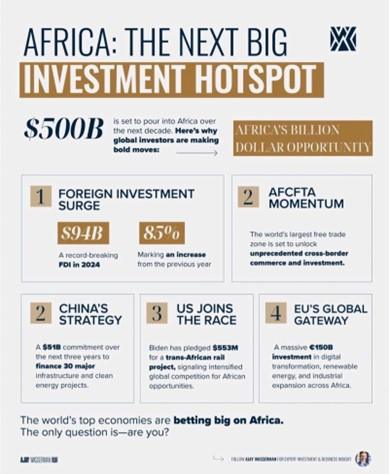
Faced with these prospects, the world’s major economic powers are intensifying their presence on the continent. Foreign direct investment flows reached a record $94 billion in 2024, an 85% increase compared to the previous year. China, already very active, plans to inject an additional $51 billion over three years, particularly in infrastructure and clean energy. The European Union, through its “Global Gateway” initiative, is mobilizing €150 billion to support Africa’s digital, energy, and industrial transformation. The United States, for its part, is strengthening its commitment with strategic infrastructure projects, illustrating the growing competition for economic influence on the continent.
One of the major drivers of this transformation is the implementation of the African Continental Free Trade Area (AfCFTA), the world’s largest free trade area. This ambitious project aims to boost intra-African trade, facilitate investment, and strengthen regional economic integration. It paves the way for a new era of cross-border trade and opportunities for local and international businesses.
Furthermore, African economies are gradually transitioning towards models less dependent on extractive industries. Improved business conditions, combined with favorable demographics and rapid urbanization, are creating an environment conducive to sustainable and diversified growth.
Ultimately, Africa is positioning itself as a future global economic powerhouse. Massive investments, the rise of a middle class, and ongoing structural reforms all point to its considerable potential. In this context, an early presence on the continent appears to be a key factor in establishing lasting trade relationships and fully capitalizing on future opportunities. Africa is no longer just a land of resources, but a strategic space where a part of tomorrow’s global economy is taking shape.