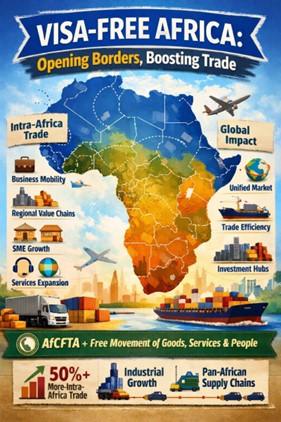
Africa is undergoing a profound transformation of the rules governing mobility and trade within its borders. Quietly but resolutely, several African countries are accelerating the adoption of simplified, or even eliminated, visa policies for citizens of the continent. This development marks a strategic turning point: it not only facilitates travel but also represents a major lever for stimulating trade, investment, and the development of regional value chains.
Beyond its political symbolism, this opening of borders has concrete economic implications. The free movement of people first and foremost fosters greater mobility for economic actors. Entrepreneurs, traders, and service providers can now move more easily, reducing delays, costs, and the informal barriers that previously hindered trade. This fluidity helps accelerate transactions and strengthen trade ties between countries.
It also enables the development of more integrated regional value chains. By facilitating travel, businesses can more efficiently organize their operations across multiple countries: sourcing raw materials, industrial processing, and product distribution. This model is particularly relevant for sectors such as agribusiness and manufacturing, where the complementarity of African economies can be fully leveraged.
Another important effect concerns informal trade and small and medium-sized enterprises (SMEs), which represent a significant share of economic activity in Africa. Simplifying travel conditions helps to formalize and expand these exchanges, offering new growth opportunities for these often essential but poorly structured actors.
The services sector is also benefiting from this momentum. Consulting, logistics, fintech, and professional services can now expand regionally with fewer constraints. This expansion fosters the emergence of companies capable of operating in multiple African markets, thereby strengthening economic integration.
Internationally, these developments are changing perceptions of the continent. Africa is increasingly seen not as a fragmented collection of 54 distinct markets, but as a unified economic space. This transformation enhances its attractiveness to foreign investors, who can now consider continent-wide strategies. Furthermore, reduced border frictions improve trade efficiency, lower costs, and strengthen the competitiveness of African exports.
Some countries are already positioning themselves as regional hubs, seeking to attract investment and serve as gateways to the African market. This strategy could play a key role in the future structuring of continental trade.
The impact of these measures is amplified by the implementation of the African Continental Free Trade Area (AfCFTA). The combination of visa liberalization and trade integration creates the conditions for the genuine free movement of goods, services, and people. This framework could increase intra-African trade by more than 50%, accelerate industrialization, reduce dependence on external markets, and foster the emergence of continental supply chains.
The resulting opportunities are numerous: integration of agricultural markets, development of cross-border logistics and storage, creation of regional industrial hubs, expansion of digital commerce and financial services, as well as growth in tourism and air transport.
Africa is therefore at a pivotal moment in its economic history. The question is no longer which country to invest in or operate in, but how to build strategies on a continental scale. This transition towards a more connected, more mobile, and more integrated Africa paves the way for a new development model, based on cooperation, innovation, and leveraging regional complementarities.