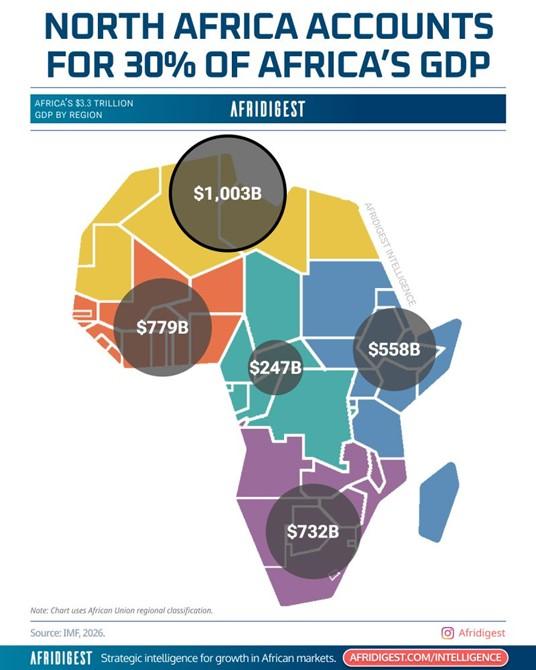
Africa exhibits profoundly contrasting economic dynamics across its different regions. Among them, North Africa stands out clearly: it alone accounts for approximately 30% of the continent’s gross domestic product (GDP), while concentrating only about 15% of its population. This imbalance underscores the relatively advanced level of development in this region, which has now established itself as Africa’s leading industrial hub.
Countries like Egypt, Morocco, and Tunisia play a central role in this performance. They are home to some of the continent’s most developed manufacturing sectors, particularly in automotive, textiles, food processing, and aerospace. This strong industrial base is partly explained by economic policies geared towards diversification, but also by a strategic geographical advantage: proximity to Europe.
Indeed, Morocco and Tunisia have particularly benefited from the phenomenon of “nearshoring,” whereby European companies relocate part of their production closer to their end markets. This strategy reduces logistics costs, improves the responsiveness of supply chains, and mitigates the risks associated with global disruptions. Thanks to this advantageous position, these countries have become more closely integrated into international value chains.
However, Africa cannot be reduced to a single dominant region. The continent comprises five major economic blocs, each with its own characteristics and levels of development. North Africa, with a GDP of approximately $1.003 trillion, leads the way, followed by West Africa ($779 billion), Southern Africa ($732 billion), East Africa ($558 billion), and finally Central Africa ($247 billion). These differences illustrate significant disparities; for example, the North African economy is four times larger than that of Central Africa, despite a relatively small demographic difference.
However, this hierarchy could change in the coming years. The East and West African regions, which together account for nearly 60% of the continent’s population, are currently experiencing the highest growth rates. They benefit from dynamic demographics, rapid urbanization, and the rise of strong domestic markets. Moreover, many of the African economies projected to be among the most dynamic in the world by 2026 are located outside of North Africa.
These developments suggest that the continent’s economic landscape is undergoing a profound transformation. While North Africa maintains a lead in industrialization and international integration, other regions are gradually catching up, driven by increasing investment and expanding domestic demand.
The current distribution of Africa’s GDP reflects past investment choices and economic policies. The future, however, will depend on the decisions made today. The regions that invest in infrastructure, education, innovation, and regional integration will shape the continent’s next phase of development.
Thus, Africa finds itself at a pivotal moment, where economic balances can be reshaped. Between the consolidation of existing hubs and the emergence of new growth centers, the continent offers a constantly expanding diversity of opportunities.