Faced with repeated disruptions to global supply chains, Africa is no longer simply reacting: it is anticipating and fundamentally transforming its economic model. Behind the scenes, a structuring dynamic is underway, marked by a growing desire to secure supplies, strengthen regional integration, and build sustainable resilience.
One of the first signs of this transformation lies in the strategic refocusing of African countries on their own markets. Increasingly, states are seeking to reduce their dependence on distant imports by developing local production and distribution capacities. The example of the Dangote refinery in Nigeria is telling: it is already generating growing interest from several African countries, which see it as an opportunity to secure their fuel supplies on a regional scale.
At the same time, energy strategies are evolving towards greater intra-African cooperation. Some countries are exploring partnerships to guarantee their access to essential resources. Botswana, for example, is considering a stake in the Lobito refinery in Angola, illustrating a new approach based on regional interdependence rather than external dependence.
This dynamic is accompanied by a gradual opening of borders. Several African countries, including Rwanda, Kenya, Seychelles, Benin, and The Gambia, are now facilitating entry for African nationals, with simplified or eliminated visa policies. This development promotes the mobility of people, stimulates tourism, and strengthens economic exchanges. Increased circulation of talent and entrepreneurs is a key driver for boosting regional markets.
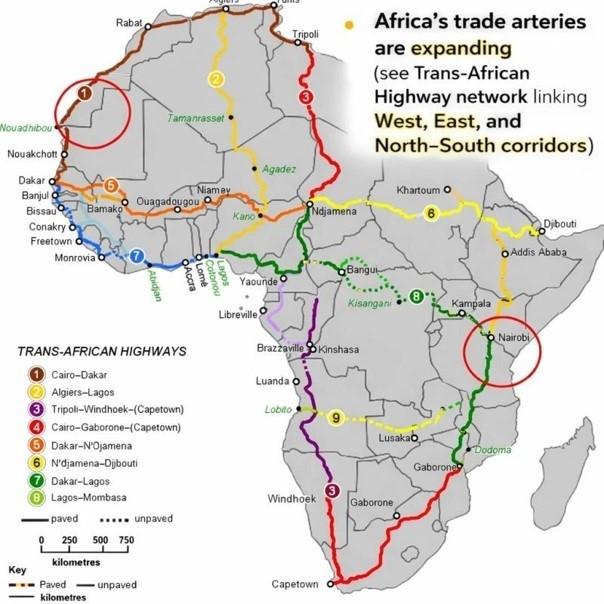
Infrastructure, long considered an obstacle to development, is also beginning to catch up with the continent’s ambitions. Large-scale projects illustrate this shift. The Abidjan-Lagos corridor, nearly 1,000 kilometers long, will connect five countries and cover approximately 75% of West Africa’s trade zone. In East Africa, corridors linking the ports of Mombasa and Dar es Salaam to landlocked countries like Uganda and Rwanda facilitate access to international markets. In Southern Africa, the Maputo corridor strengthens connections between industrial centers and global ports.
On a broader scale, the African Continental Free Trade Area (AfCFTA) forms the foundation of this transformation. By uniting 54 countries in a $3.4 trillion market, it offers considerable potential to boost intra-African trade, with an estimated increase of over 50%. This project aims to reduce trade barriers, harmonize regulations, and create an integrated economic space.
These developments reflect a clear trend: Africa is seeking to bring its supply chains closer together, produce locally, and accelerate its internal trade. This “regional relocation” strategy helps reduce costs, improve responsiveness, and strengthen resilience to external shocks.
In conclusion, the ongoing transformation is not based on a one-off reaction to crises, but on a structural overhaul of the economic system. By developing its own capacities and strengthening its interconnections, Africa is laying the foundations for a more autonomous and sustainable model. This dynamic marks a decisive step towards greater economic sovereignty, where the continent no longer merely endures global developments, but actively participates in shaping them.