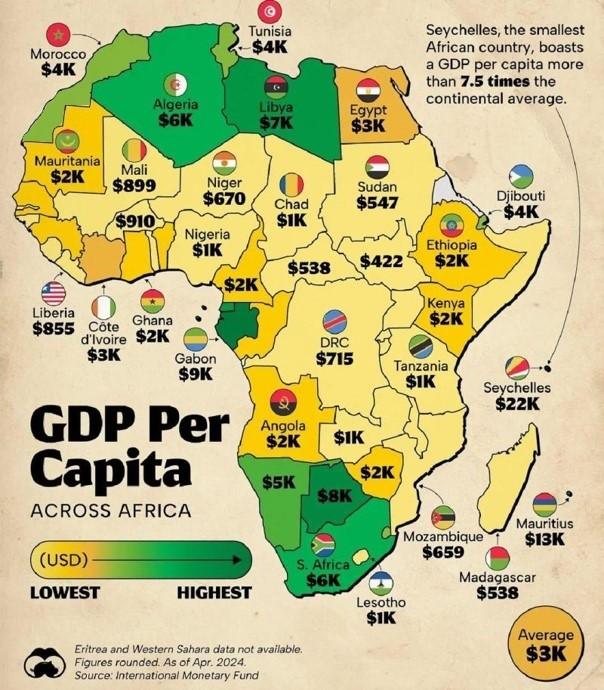
Gross domestic product (GDP) per capita at purchasing power parity (PPP) is one of the most relevant indicators for assessing the real standard of living. Unlike nominal measures, it takes into account differences in the cost of living between countries, thus providing a more accurate picture of citizens’ purchasing power. According to data from the International Monetary Fund (IMF), the ranking of African countries in 2026 reveals interesting and sometimes counterintuitive structural trends.
At the top of the ranking are two small island states: the Seychelles, with a GDP per capita of nearly $43,849, followed by Mauritius with $34,830. Their dominant position is explained by economies geared towards high value-added sectors, particularly high-end tourism and financial services. Their relatively small population size also allows for a better distribution of wealth, contributing to a high standard of living.
Gabon ranks third with $25,289 per capita. This result is largely due to the exploitation of its oil resources, combined with a relatively small population. However, this dependence on hydrocarbons poses challenges in terms of economic diversification and long-term sustainability.
Egypt, ranked fourth with $22,691, is a notable surprise. This ranking is explained by a combination of factors, including a relatively low cost of living and a diversified economy encompassing industry, agriculture, and services. Despite its large population, the country manages to maintain a relatively competitive standard of living on a continental scale.
Equatorial Guinea, fifth with $20,377, remains high in the rankings despite a decline compared to its years of strong oil growth. Botswana ($19,536) and Algeria ($19,139) follow, benefiting respectively from their diamond and hydrocarbon resources. These countries illustrate economic models still largely dependent on raw materials, but which are gradually seeking to diversify.
Libya, with $18,837, and South Africa, with $16,283, complete the ranking. In the case of South Africa, however, this figure masks significant internal inequalities, which limit the true impact of this wealth on the population as a whole. Finally, Tunisia closes out the top 10 with $15,456, narrowly ahead of Morocco, which ranks eleventh.
Analysis of this ranking highlights several key findings. First, countries with large populations, such as Nigeria, Ethiopia, and the Democratic Republic of Congo, are absent, underscoring that population size does not necessarily translate into a high standard of living. Second, the dominant economies are either small and highly specialized, rich in natural resources, or relatively diversified.
The ranking of GDP per capita in Africa reveals a contrasting economic reality. It highlights the development gaps between countries, but also the different growth models at work across the continent. To sustainably improve living standards, numerous challenges remain: economic diversification, reducing inequality, and investing in human capital. These elements will be crucial in enabling more African countries to reach the top of this ranking in the future.