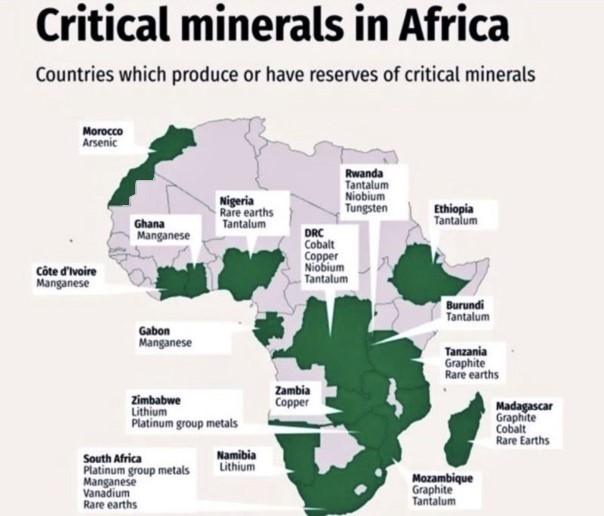
As the world embarks on an accelerated transition towards electrification, clean energy, and digitalization, Africa is emerging as one of the planet’s most strategic regions. At the heart of this global transformation lie so-called “critical” minerals, essential for manufacturing the technologies that will define the next industrial era. From cobalt and lithium to rare earth elements and graphite, the African continent holds key resources to power electric vehicle batteries, wind turbines, and advanced technological systems.
This mineral wealth is distributed across several major geographical areas. The Democratic Republic of Congo largely dominates global cobalt production, while also possessing significant reserves of copper, niobium, and tantalum. South Africa stands out for its platinum group metals, manganese, vanadium, and rare earth elements. Zimbabwe and Namibia are emerging as major players in lithium production, while Tanzania and Madagascar are positioning themselves in graphite and certain rare earth elements. Other countries, such as Nigeria, Rwanda, and Zambia, are also playing an increasing role in the exploitation of these strategic resources.
The importance of these minerals extends far beyond the extractive sector. They are central to the clean technology revolution and determine economies’ ability to achieve their climate goals. For example, over 60% of the world’s cobalt already comes from African mines, highlighting the continent’s pivotal role in global supply chains. Meanwhile, lithium and rare earth production is expanding rapidly, driven by growing demand related to the energy transition.
However, the real challenge for Africa lies not only in the extraction of these resources, but also in their local processing. Increasingly, African governments and international investors are interested in developing refining and processing capacity on the continent. This development could allow Africa to capture a larger share of the added value, create skilled jobs, and strengthen industrialization.
If these resources are exploited strategically and sustainably, they could generate substantial economic benefits. Revenues from critical minerals could finance massive investments in infrastructure, education, and green technologies, thus contributing to inclusive and sustainable growth. Africa would then no longer be just a supplier of raw materials, but an essential partner in the global energy transition.
Critical minerals place Africa at the heart of the economic and environmental challenges of the 21st century. They represent both a unique opportunity and a major responsibility. How the continent manages this wealth will determine its ability to fully integrate into global value chains and play a leading role in the economy of tomorrow.