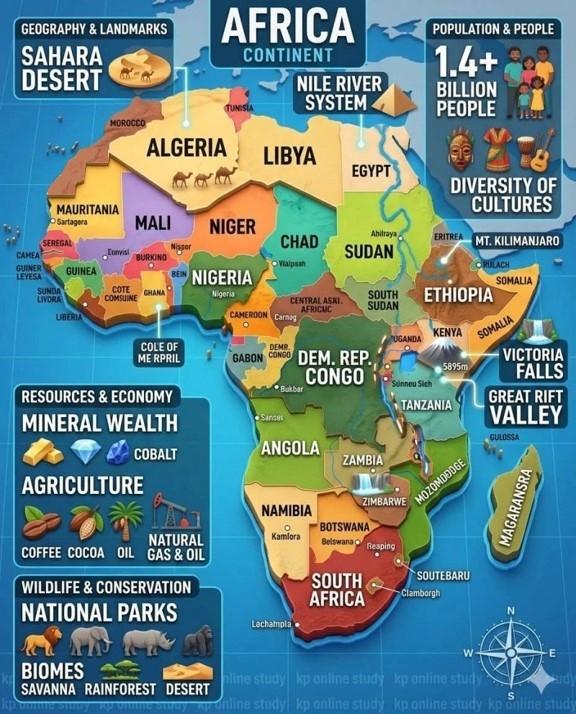
Africa, the world’s second largest continent and second most populous, occupies a central place in global geographical, cultural, and economic balances. Spanning approximately 30 million square kilometers—nearly 20% of the Earth’s landmass—it is distinguished by an exceptional diversity that makes it one of the most fascinating regions on the planet.
Geographically, Africa has unique characteristics. It is the only continent to extend into both the temperate zones of the Northern and Southern Hemispheres, crossing the equator. This position gives it a wide variety of climates and landscapes. Among its most iconic features are the Sahara Desert, the largest hot desert in the world; the Nile River, historically considered the longest river on Earth; and Mount Kilimanjaro, the highest freestanding mountain on the planet. The continent is also home to significant bodies of water, such as Lake Victoria, the largest tropical lake in the world, and Lake Tanganyika, reputed to be the second deepest.
Africa is also a true sanctuary of biodiversity. It is world-renowned for its unique ecosystems and exceptional wildlife. The vast savannas of the Serengeti, the dense rainforests of the Congo Basin, and the arid landscapes of the Namib Desert offer diverse habitats for a multitude of species. The continent is home to some of the largest remaining populations of megafauna, including elephants, lions, rhinoceroses, and giraffes. This natural wealth constitutes a world heritage of inestimable value.
Demographically, Africa stands out for its youth and vitality. With over 1.4 billion inhabitants, it has the youngest population in the world, with a median age often under 20. This characteristic represents a major asset for future development, provided that investment is made in education, training, and employment. Furthermore, the continent is marked by exceptional cultural diversity, with thousands of ethnic groups and more than 2,000 languages. This cultural richness is reflected in traditions, lifestyles, and artistic expressions.
Africa has 54 recognized sovereign states, each with its own political and economic characteristics. Nigeria is the most populous country, while Algeria is the largest in terms of land area. This mosaic of nations contributes to the continent’s complexity and richness, but also poses challenges in terms of regional integration and governance.
Economically, Africa possesses abundant natural resources, including a significant share of the world’s gold, diamond, cobalt, and platinum reserves. These resources represent a major driver of development. At the same time, many African countries are experiencing rapid growth in emerging sectors such as digital technologies, renewable energy, and urbanization. These transformations reflect an ongoing dynamic of modernization and innovation.
Africa is much more than just a geographical space: it is a continent in full evolution, rich in resources, youth, and diversity. Challenges remain numerous, but so do the opportunities. In a changing world, Africa is emerging as a key player whose role will only continue to grow in the coming decades.