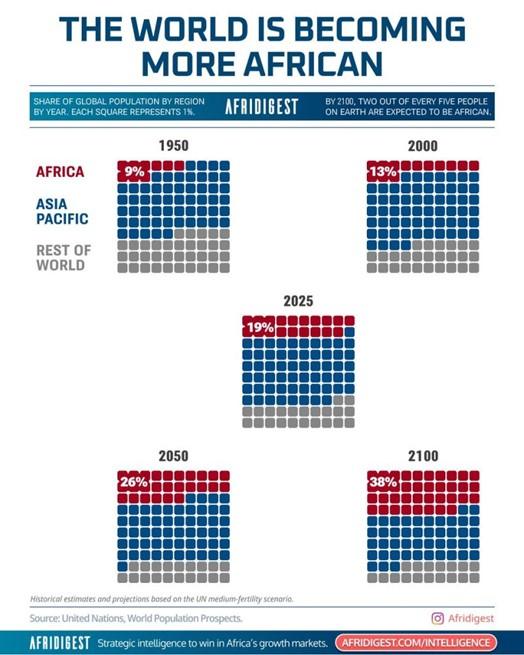
Global demographic history is taking a major turn, and Africa is now at its center. In 1950, the continent represented only about 9% of the world’s population. Today, in 2025, that share is expected to reach nearly 19%. According to United Nations projections, it should rise to around 26% by 2050, and then to nearly 38% by 2100. In other words, nearly two out of every five people in the world could be African by the end of the century. This is one of the most significant demographic transformations of the modern era.
This rapid growth is not merely a statistical phenomenon. It carries profound economic, social, and geopolitical implications. Such demographic weight has the potential to redefine labor markets, consumption patterns, capital flows, innovation hubs, and even political influence on a global scale. With approximately 1.5 billion inhabitants today, and a population projected to continue growing throughout the century, Africa is gradually establishing itself as a key player in the global future.
However, while demographics are a strong indicator, they do not alone guarantee development and prosperity. History shows that population size, however large, is not enough to create wealth. What will make the difference are the strategic choices made today. The capacity of African institutions to support this population growth will be crucial.
Several key factors influence this transformation. First, the quality of the execution of public policies and economic projects is essential. A vision without effective implementation does not produce lasting results. Second, governance plays a central role: strong, transparent, and accountable institutions are indispensable for attracting investment and ensuring inclusive growth.
Access to energy is also a fundamental lever. Without reliable energy infrastructure, it is difficult to support industrialization, innovation, and job creation. Added to this is the need to massively develop professional opportunities for a rapidly growing young population. Job creation, particularly in productive sectors, will be crucial to preventing social inequalities.
Education represents another essential pillar. Training a generation capable of meeting the demands of a modern economy is crucial to transforming demographic potential into economic advantage. Finally, transparency and sound management of public resources strengthen trust and foster an environment conducive to development.
Thus, the “African century” will not be achieved automatically through statistics. It will depend on the ability of leaders and societies to anticipate, plan, and invest in the foundations of the future. Population growth offers a historic opportunity, but it also demands greater responsibility.
As Africa represents an increasing share of humanity, a fundamental question arises: will this demographic weight translate into greater influence in global affairs? The answer will depend on the choices made today. If the continent manages to transform its demographic momentum into economic and institutional power, it could redefine its place in the world and become one of the main drivers of the 21st century.